

Average handling time has quietly become one of the most stubborn constraints in e-commerce customer support. As order volumes grow and customer expectations tighten, support teams are asked to resolve more complex issues without slowing down. Many brands respond by adding scripts, macros, or more agents. Few stop to question whether the agent’s workflow itself is the bottleneck.
This is where Reducing Average Handling Time in E-commerce CRM with AI Copilot Assistance becomes a meaningful operational conversation. To reduce average handling time with AI copilot support is not about rushing agents or cutting corners. It is about removing the friction that forces them to search across systems, reconstruct context, and repeat validation steps on every ticket.
In Indian e-commerce, where queries often span order status, delivery exceptions, and returns in a single interaction, average handling time is shaped as much by context access as by agent skill. Understanding why handling time inflates, and how assistive intelligence inside the CRM changes that dynamic, requires looking beyond dashboards and into how agents actually work minute by minute.
Why does average handling time inflate in e-commerce support operations?
Hidden workflow friction compounds across every customer interaction
Average handling time in ecommerce is rarely driven by a single inefficiency. It grows through small, repeated frictions that agents encounter on nearly every ticket. As order volumes scale, these frictions multiply faster than headcount or scripts can compensate.
Common contributors include:
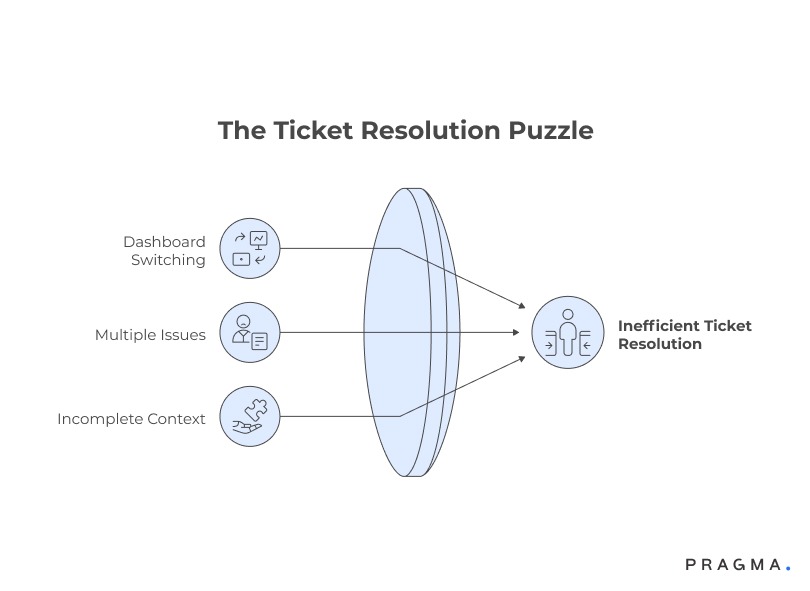
- Agents switching between CRM, order management, and logistics dashboards
- Customers raising multiple issues in one conversation
- Incomplete context at the time the ticket is opened
Each interruption adds seconds, then minutes, to a single interaction. Over thousands of tickets, this becomes systemic drag rather than individual underperformance. Teams often respond by tightening scripts or pushing speed targets, which can worsen resolution quality without addressing the root cause.
This is why discussions around average handling time in ecommerce must start with workflow design rather than agent behaviour.
How does CRM fragmentation directly impact handling time?
Context loss forces agents to rebuild information repeatedly
CRMs are meant to centralise customer data, yet in practice they often act as thin layers over disconnected systems. Order details, delivery updates, and past interactions live in separate tools, accessed only when agents actively search for them.
When customers ask why an order is delayed, agents typically:
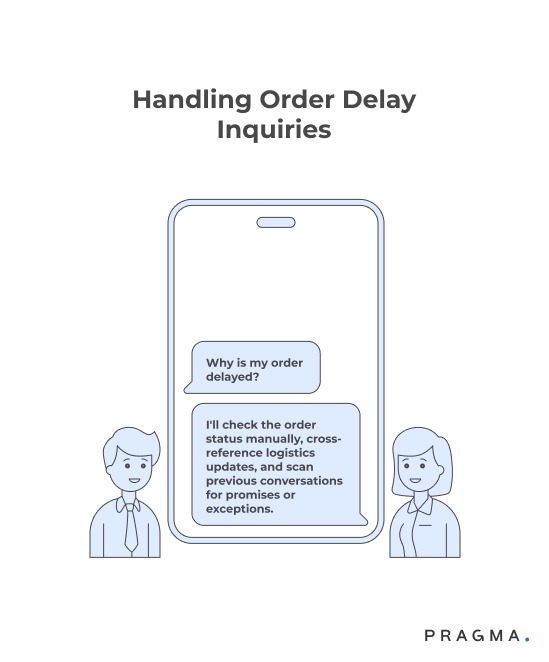
- Check order status manually
- Cross-reference logistics updates
- Scan previous conversations for promises or exceptions
This manual reconstruction inflates average handling time in CRM even for experienced agents. The problem becomes more pronounced during peak periods, when systems slow down and cognitive load increases.
The operational cost is not just time. Repeated context switching increases error rates and agent fatigue, creating a feedback loop that further degrades performance.
Why do common AHT reduction tactics plateau quickly?
Scripts and macros improve speed but not understanding
Most teams attempt to reduce AHT by standardising responses. Macros, canned replies, and strict talk tracks can shave time off simple queries. However, these tools assume that the problem is communication speed rather than information access.
In reality:
- Scripts break when issues deviate from the happy path
- Macros still require agents to verify accuracy
- Faster replies do not guarantee faster resolution
As a result, teams see early gains followed by stagnation. Handling time stabilises at a new baseline, but does not continue to improve. This is often when leaders begin exploring how to reduce average handling time without sacrificing customer experience.
When does average handling time become a strategic risk?
Operational drag affects cost, experience, and scalability
Rising AHT is not just an efficiency metric. It directly impacts cost per ticket, queue backlogs, and customer satisfaction. More importantly, it limits how well support operations can scale during sales events or seasonal spikes.
High AHT signals that agents are spending time assembling context rather than resolving issues. In Indian e-commerce, where “Where is my order?” remains the most frequent query, this becomes especially visible. Patterns behind this query, and why it drives handling time, are explored naturally within
At this stage, improving AHT requires rethinking how intelligence is delivered to agents, not just how quickly they respond.
How does AI copilot assistance change the handling time equation?
Assistive intelligence removes lookup time from agent workflows
AI copilots approach the AHT problem from a different angle. Instead of asking agents to work faster, they reduce the amount of work required per interaction. The core shift lies in how context is delivered.
When a ticket opens, copilots can surface:
- Order status and shipment history
- Past conversations and unresolved issues
- Customer-specific flags or exceptions
This information appears inside the CRM view, without manual searching. As a result, agents spend less time reconstructing context and more time resolving the actual issue. This is where teams begin to reduce average handling time with AI copilot support in a sustainable way.
The improvement is incremental per ticket, but significant at scale.
Why does embedded assistance outperform standalone automation?
Reducing cognitive load matters more than response speed
Standalone automation tools often operate outside the agent workflow. Even when they capture information upfront, agents must still verify, interpret, and act on that data.
Copilots differ because they work alongside agents. They highlight relevant data points, suggest responses, and flag policy constraints whilst the agent is actively handling the ticket. This reduces cognitive load, which is one of the least measured but most impactful drivers of handling time.
Lower cognitive load leads to:
- Faster decision-making
- Fewer mistakes that require rework
- More consistent handling across agents
This is particularly visible when copilots are embedded directly within the CRM, as discussed within where intelligence is applied at the point of action rather than after the fact.
How does contextual recall shorten complex conversations?
Fewer clarifying questions lead to faster resolution
Complex tickets often stretch handling time because agents must ask multiple clarifying questions. Customers repeat information, agents verify details, and conversations elongate.
With contextual recall, copilots can pre-empt many of these steps by presenting:
- What the customer has already reported
- Whether similar issues occurred previously
- Which resolutions were applied successfully
This allows agents to move directly to resolution paths instead of discovery. Over time, this materially improves average handling time in ecommerce, especially for repeat or multi-issue tickets.
When should teams expect meaningful AHT improvements?
Early gains appear once context access is stabilised
Copilot-led AHT reduction does not require full workflow redesign on day one. Teams typically see early improvements once the most time-consuming lookups are removed.
Meaningful gains often emerge when:
- Order and logistics data are reliably surfaced
- Past interactions are visible without searching
- Agents trust the surfaced context
At this stage, improvements in average handling time in CRM are driven by confidence and clarity rather than speed pressure. Agents resolve issues faster because they know more, not because they are rushing.
This reframes how to reduce average handling time as an enablement problem rather than a performance management one.
How can teams reduce average handling time within 30 days using AI copilots?
Targeted workflow fixes that remove delay before speed optimisation
How to reduce average handling time in the first month
Week 1: Identify the top three time sinks inside live tickets
Review recent tickets with the highest handling time and document where agents pause to search, verify, or escalate. Focus on order status, delivery exceptions, and returns.
Expected result: Clear visibility into which lookups inflate handling time the most.
Week 2: Surface order and logistics context inside the CRM view
Ensure agents can see order status, shipment updates, and delivery timelines without leaving the CRM. When “Where is my order?” queries dominate queues,removing these lookups alone shortens conversations significantly.
Expected result: Faster responses on the most frequent ticket category.
Week 3: Introduce copilot-led suggestions for repetitive decisions
Configure copilots to recommend next best actions or responses based on ticket context, without auto-executing them. Agents retain control but skip repetitive reasoning.
Expected result: Reduced thinking time on common but variable scenarios.
Week 4: Standardise trust and feedback loops
Train agents on when to rely on copilot context and when to override it. Capture feedback on inaccurate suggestions to refine models.
Expected result: Consistent reductions in handling time without loss of resolution quality.
Which metrics show whether AI copilot assistance is actually reducing AHT?
Operational signals that reflect real efficiency gains
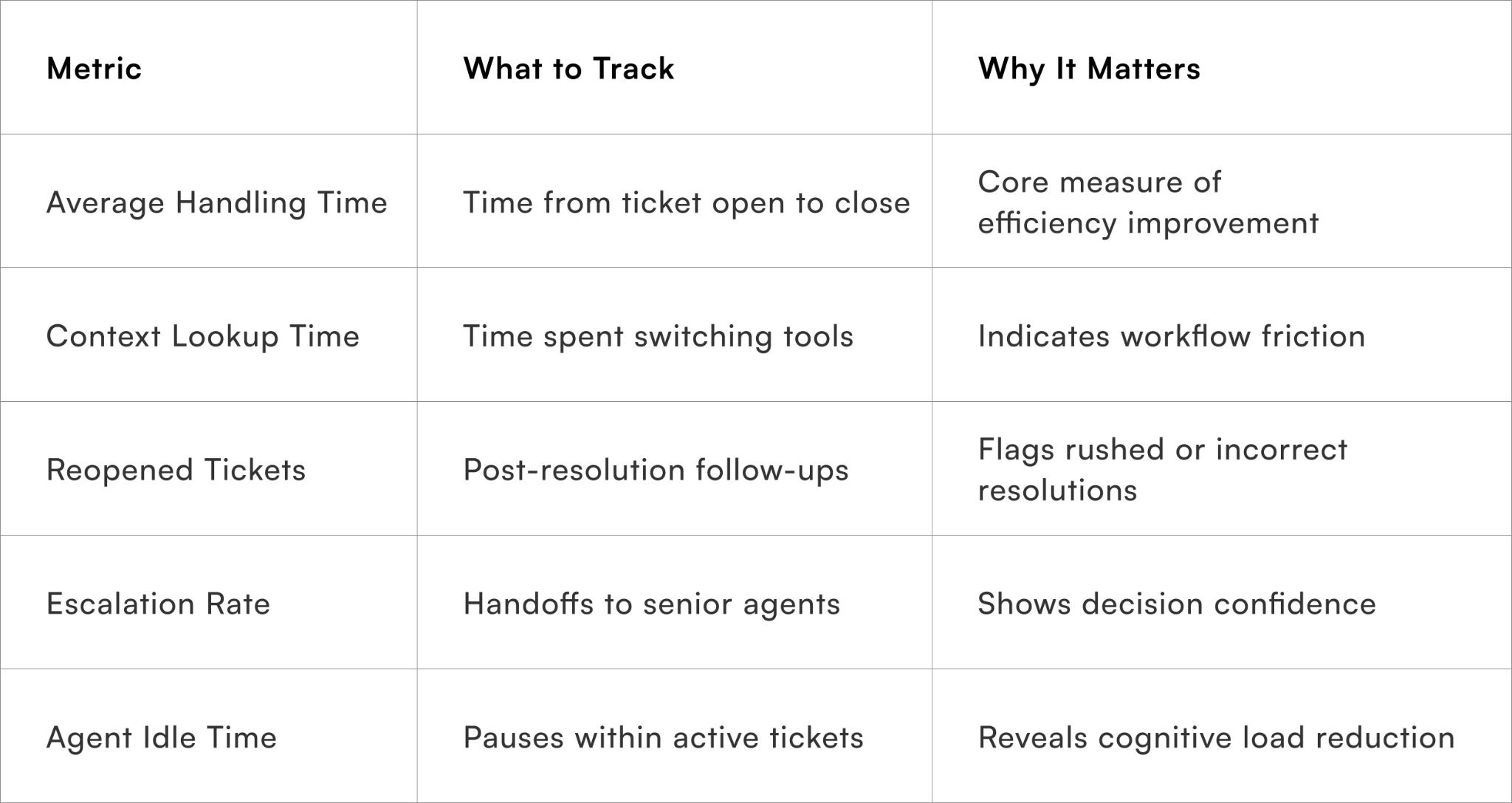
Tracking these together helps teams confirm whether they truly reduce average handling time with AI copilot assistance, rather than shifting effort elsewhere.
How does sustained AHT reduction change CRM performance over time?
Efficiency gains compound when context stays accessible
When copilots remain embedded within the CRM, improvements in average handling time in CRM tend to compound rather than plateau. Agents develop muscle memory around faster decision-making, and new hires ramp up quicker because context is consistently visible.
This effect is strongest when copilots are deeply integrated into CRM workflows, where intelligence is delivered at the exact moment agents act. Over time, teams move from firefighting delays to proactively managing support capacity.
To Wrap It Up
Reducing handling time in e-commerce support is not about speeding up agents, but about removing the friction that slows them down. When context is delivered at the right moment, decisions become faster and more consistent.
This week, audit where agents leave the CRM during high-volume tickets and prioritise eliminating those lookups.
Over the long term, teams that treat AHT as a workflow design problem see sustained improvements rather than temporary gains. Continuous refinement of copilot suggestions and context sources ensures efficiency scales with complexity.
For D2C brands seeking to reduce average handling time with AI copilot assistance, Pragma’s AI Copilot platform provides CRM-native context surfacing, decision support, and agent-first workflows that help brands resolve tickets faster without compromising quality.

FAQs (Frequently Asked Questions On Reducing Average Handling Time in E-commerce CRM with AI Copilot Assistance)
1. What does it mean to reduce average handling time with AI copilot?
To reduce average handling time with AI copilot means using AI assistance to speed up customer interactions and task resolution. It helps agents handle queries faster while maintaining quality.
2. How to reduce average handling time in customer support?
How to reduce average handling time involves automation, better workflows, and real-time assistance.AI copilots streamline responses and reduce manual effort.
3. What is average handling time in ecommerce?
Average handling time in ecommerce refers to the time taken to resolve customer queries or complete support interactions. Lower AHT improves efficiency and customer satisfaction.
4. What is average handling time in CRM systems?
Average handling time in CRM measures the duration agents spend managing customer interactions across channels. It is a key metric for operational performance.
5. How does AI copilot help reduce average handling time?
Reducing average handling time in e-commerce CRM with AI copilot assistance involves real-time suggestions and automation. This reduces response delays and improves agent productivity.
6. Can AI copilots automate repetitive tasks in CRM workflows?
Yes, AI copilots can automate tasks like data entry, ticket classification, and response drafting. This significantly reduces handling time per interaction.
7. How does real-time assistance impact average handling time?
Real-time insights and suggested replies help agents respond faster and more accurately. This directly lowers average handling time.
8. Does reducing average handling time affect service quality?
When done correctly, it improves both speed and quality of service.AI ensures consistency while agents maintain control.
9. What data is required to optimise average handling time?
Data such as interaction history, response times, and resolution patterns is essential. This helps AI copilots provide accurate recommendations.
10. Can AI copilots scale across large support teams?
Yes, they provide consistent assistance across teams and channels. This ensures uniform reduction in handling time at scale.
11. What are the benefits of reducing average handling time in CRM?
Benefits include improved efficiency, lower operational costs, and better customer experience. It also enables teams to handle higher volumes effectively.
Talk to our experts for a customised solution that can maximise your sales funnel
Book a demo


.png)