

Failed deliveries are inevitable at scale, but treating every NDR (Non-Delivery Report) the same is where most D2C operations lose margin, time, and customer goodwill. Some orders are genuinely unsalvageable, while others fail for reasons that can be corrected quickly with the right intervention. Without a clear triage framework, teams either over-invest effort in low-value recoveries or under-react to orders that could have been saved.
NDR triage framework: how to prioritise salvageable orders looks at NDRs through an operational lens rather than a reactive support workflow. It focuses on how logistics and ops teams can systematically classify failed deliveries, decide which ones deserve immediate action, and route them through the right recovery paths.
Instead of chasing every exception, the goal is to maximise recovered value per unit of effort. By combining order value, failure reason, buyer responsiveness, and carrier behaviour, teams can turn NDR handling from a cost centre into a controlled, measurable recovery process.
Why do most NDR workflows break down at scale?
Because operational effort is disconnected from recovery probability
Treating all NDRs as equal hides recoverable value
In many D2C operations, the moment an order enters NDR status, it is routed into a single recovery flow. The system does not ask whether the order is worth saving, how likely recovery is, or what kind of intervention is required. An incorrect pincode, a delayed delivery attempt, and a clear customer refusal are all handled with the same cadence.
This approach creates two compounding problems. First, high-probability recoveries are delayed because teams are overloaded with low-yield cases. Second, repeated follow-ups on unrecoverable orders inflate support effort without improving outcomes. Over time, this leads to higher RTOs, longer recovery cycles, and growing operational fatigue.
Why uniform handling increases RTO instead of reducing it
Uniform workflows slow down response times for the very orders that need speed. Salvageable NDRs often have a short recovery window; missing it converts a fixable issue into a failed delivery. Without prioritisation, teams lose that window.
What defines a salvageable NDR in operational terms?
Recovery success depends on intent, effort, and timing
Order value determines how much effort makes sense
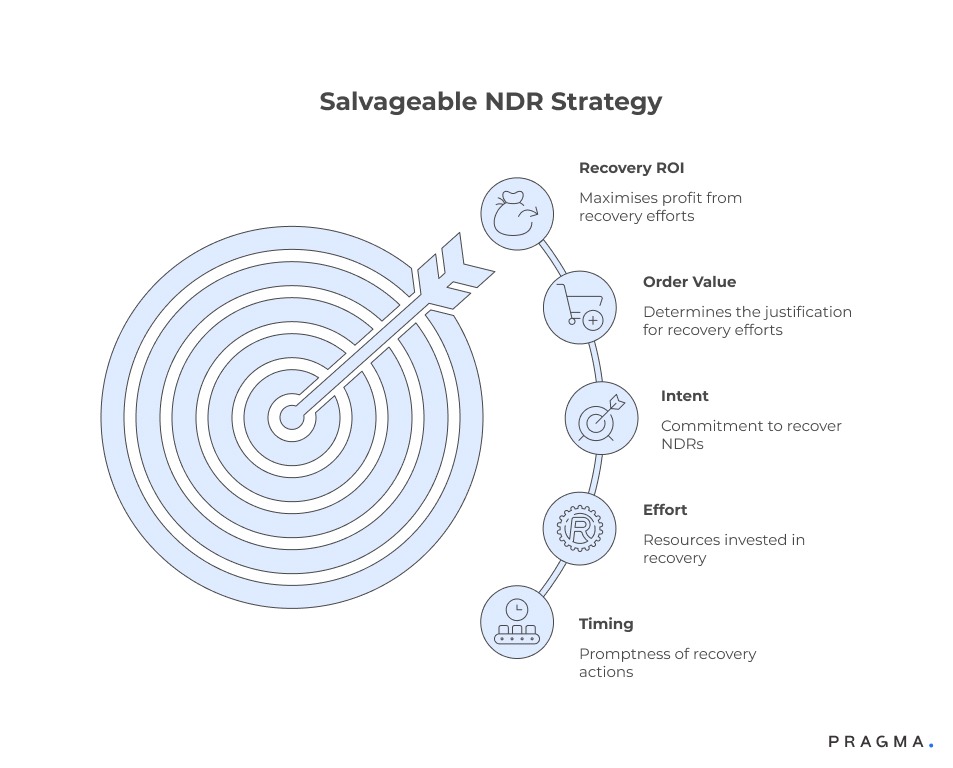
Every recovery action has a cost — in agent time, system triggers, and carrier coordination. High-value orders, prepaid shipments, and bundles with strong contribution margins justify more intensive recovery attempts because the upside is clear. Low-value COD orders, by contrast, reach diminishing returns very quickly.
Value-based prioritisation does not mean abandoning lower-value orders. It simply ensures that the most recoverable revenue receives attention before effort is exhausted elsewhere. This shift alone often improves overall recovery yield without increasing team size.
Moving from recovery rate to recovery ROI
Teams that focus only on recovery percentage often miss the bigger picture. Recovering fewer orders but at higher value frequently delivers better margins than chasing every NDR equally.
Failure reason reveals buyer intent more clearly than volume
The reason an order failed is often the strongest indicator of whether it can be recovered. Address issues, delivery timing conflicts, or temporary unavailability usually indicate intent to receive. Refusals, repeated non-responsiveness, or explicit rejection suggest low salvage probability.
The problem is not lack of data, but lack of interpretation. When all failure reasons are grouped under a single “NDR” label, teams lose the ability to act intelligently.
Grouping failure reasons by fixability
Operationally, failure reasons should be translated into recovery categories rather than left as raw carrier codes. This allows faster routing, clearer playbooks, and better use of limited recovery windows.
How buyer behaviour signals recovery probability
Past behaviour predicts future acceptance
Responsiveness is a stronger signal than promises
Buyers who respond quickly to delivery confirmations, NDR messages, or reschedule requests consistently show higher recovery rates. Conversely, buyers who ignore multiple attempts rarely convert, regardless of how many follow-ups are sent.
Using responsiveness as a signal helps teams prioritise where intervention will actually work. It also prevents unnecessary escalation that irritates buyers who have already disengaged.
Why response speed matters more than response count
Fast responses indicate active intent. Delayed or absent responses often signal disinterest, incorrect contact details, or changed buyer priorities. Prioritising by response latency improves recovery efficiency without increasing touchpoints.
Why carrier behaviour must be part of NDR triage
Some failures are systemic, not buyer-driven
Carrier-specific NDR patterns distort recovery efforts
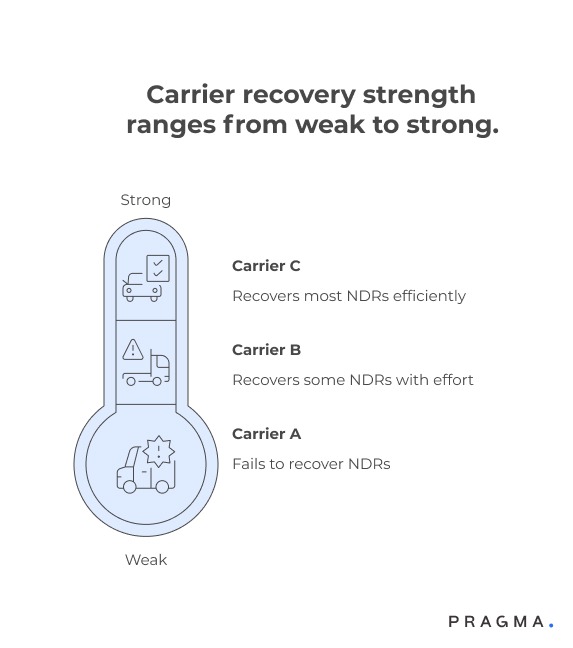
Certain carriers generate higher NDR volumes in specific regions, product categories, or time periods. These failures may stem from operational overload, poor route planning, or weak last-mile execution rather than buyer issues.
If triage ignores carrier context, teams waste time contacting buyers when the real fix lies in rescheduling, reassignment, or escalation within the carrier network.
Aligning triage urgency with carrier recovery strength
Some carriers handle second attempts well; others do not. Knowing which carriers recover successfully allows teams to prioritise NDRs where operational fixes have a high chance of success.
How can NDR triage be operationalised without slowing teams down?
Turning recovery signals into fast, repeatable decisions
Why triage must happen before recovery begins
In most setups, recovery actions begin the moment an NDR is raised. Calls are triggered, messages are sent, and agents start chasing buyers before any assessment is made about whether the order is actually worth saving. This reactive approach overwhelms teams during peak periods and reduces the attention available for high-probability recoveries.
Effective triage flips the sequence. Before any action is taken, the system evaluates the order across a small set of recovery signals and decides how much effort is justified. This upfront filtering ensures that speed is reserved for the orders where it materially improves outcomes.
Why early triage improves speed, not bureaucracy
When prioritisation happens early, agents no longer need to decide case by case. The system routes NDRs into predefined paths, allowing faster execution with less cognitive load.
What does a practical NDR scoring model actually look like?
Simple enough to trust, strong enough to guide action
Combining value, intent, and feasibility into one score
A usable NDR scoring model does not try to predict delivery success with mathematical precision. Instead, it answers a simpler question: Is this order worth urgent recovery effort right now?
To do that, it blends four signals — order value, failure reason, buyer responsiveness, and carrier recovery capability — into a single prioritisation score.
The purpose of the score is not ranking accuracy but operational clarity. Teams should be able to explain why an order was prioritised or deprioritised without opening a dashboard.
Why explainability matters in ops environments
If agents cannot intuitively understand why an order is marked high or low priority, they will override the system. Simple logic builds trust and adoption.
Translating signals into weighted inputs
Each signal plays a distinct role in recovery success and should be weighted accordingly.
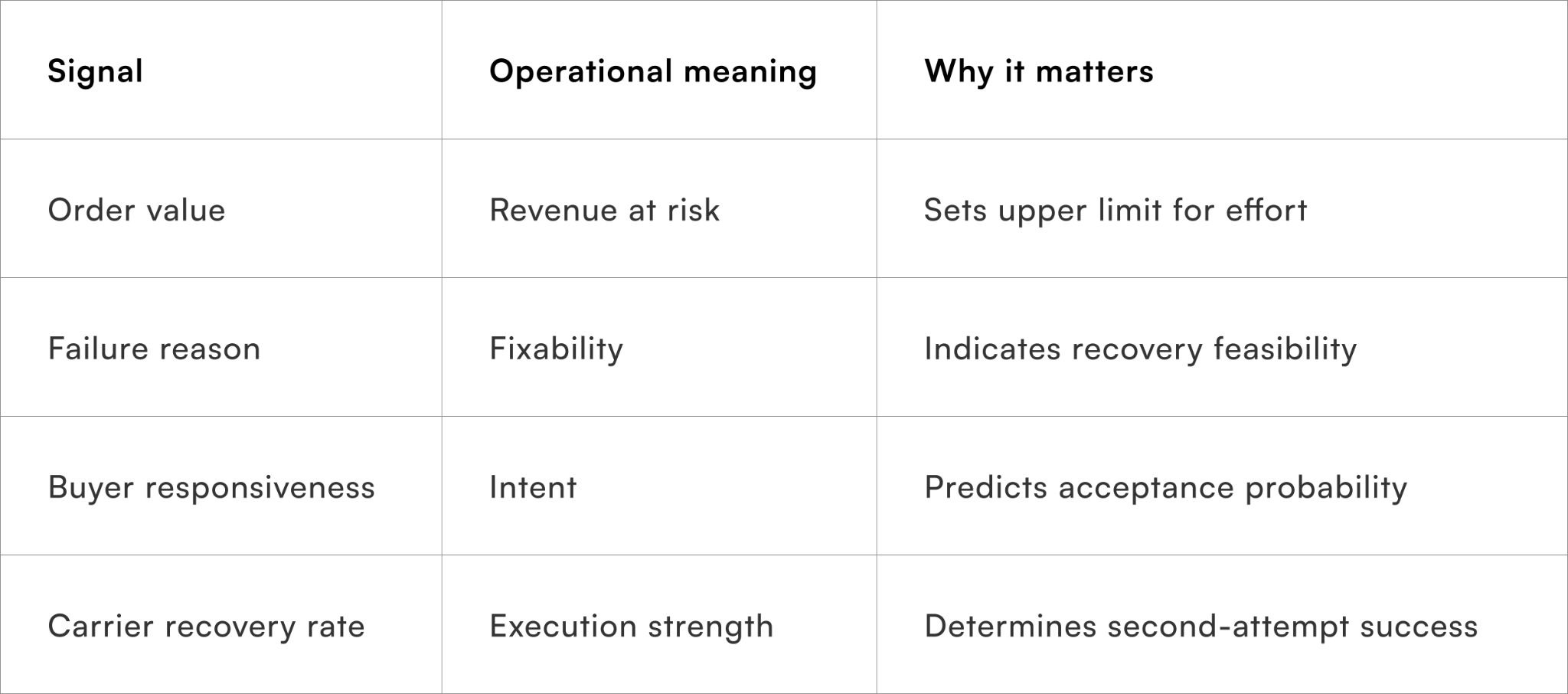
Rather than exact rankings, scores should be grouped into priority bands that directly map to recovery actions.
Why priority bands work better than exact scores
Agents and workflows need decisions, not decimals. Bands remove ambiguity and speed execution.
How should different NDR priority bands be handled?
One NDR state, multiple recovery paths
High-priority NDRs — when speed directly saves revenue
High-priority NDRs typically involve high-value orders, fixable issues, and responsive buyers. These orders should trigger immediate corrective actions such as address confirmation, delivery rescheduling, or carrier escalation within hours of failure.
Speed is critical because buyer intent decays quickly after a failed attempt. The longer teams wait, the more likely the buyer disengages or refuses delivery.
Why high-priority NDRs should bypass queues
Any delay caused by batching or manual review reduces salvage probability. These orders must jump the line.
Medium-priority NDRs — structured effort with clear limits
Medium-priority NDRs sit in a grey zone. The buyer may not be immediately responsive, or the order value may not justify aggressive intervention. These cases benefit from controlled, time-bound follow-ups rather than continuous chasing.
Clear attempt limits and wait windows prevent these orders from silently consuming operational capacity without meaningful recovery gains.
Preventing recovery drift in medium-priority cases
Without limits, these orders often linger until they turn into inevitable RTOs. Structured exits protect team focus.
Low-priority NDRs — deciding when not to recover
Explicit refusals, repeated non-responses, and low-value orders with poor carrier recovery history should exit recovery flows early. Continuing effort on these orders rarely changes outcomes and increases holding and handling costs.
Fast exits are not failures — they are margin-protecting decisions.
Why early RTO is sometimes the optimal outcome
Reducing dead inventory time and warehouse congestion often delivers more value than chasing unlikely recoveries.
How does automation strengthen NDR triage outcomes?
Consistency during peak volumes
Automating routing instead of actions
Automation should not blindly send messages or calls. Its real value lies in routing decisions — deciding which workflow an NDR enters, how fast it moves, and when it exits.
Once priority bands are defined, automation ensures every NDR is treated consistently, even during flash sales or festive peaks when manual judgement breaks down.
Reducing agent fatigue without losing control
Automation handles volume and consistency, while agents focus on complex or high-impact recoveries.
What guardrails keep triage from becoming too rigid?
Optimisation without blind spots
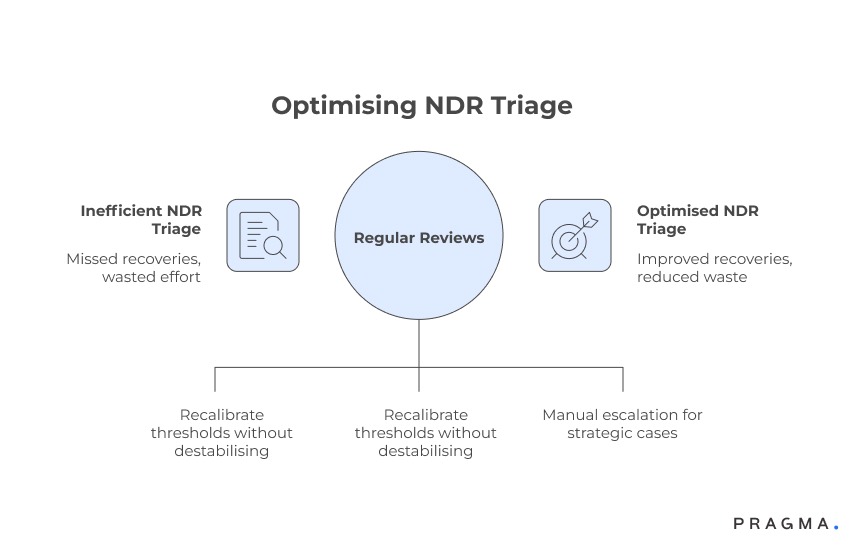
Monitoring missed recoveries and wasted effort
No triage system is perfect. Some low-priority orders will convert, and some high-priority ones will fail. Regular reviews of false positives and negatives help recalibrate thresholds without destabilising workflows.
Preserving human override for strategic cases
VIP buyers, high-risk SKUs, or regulatory constraints should always allow manual escalation. Triage guides decisions — it should never eliminate judgement.
Quick wins for implementing NDR triage in live operations
Practical steps to improve recovery without adding headcount
Week 1: Segment NDRs before taking action
Begin by analysing recent NDRs and tagging them by order value, failure reason, buyer responsiveness, and carrier. Even a basic manual segmentation highlights where recovery effort is being wasted.
By the end of the week, teams should be able to clearly identify which NDR categories consistently convert and which rarely do.
Week 2: Define priority bands and recovery playbooks
Translate segmentation into three clear priority bands — high, medium, and low. For each band, define the maximum number of attempts, allowed channels, and exit conditions.
This ensures agents stop improvising and start following predictable, outcome-driven workflows.
Week 3: Automate routing and time limits
Implement simple automation to route NDRs into the right recovery path and enforce time-bound exits.
After 30 days, teams typically see faster recoveries for high-priority orders and fewer stalled cases clogging the system.
Metrics that indicate a healthy NDR triage system
What to measure once prioritisation is live
A strong NDR framework improves not just recovery rates, but recovery efficiency. The metrics below help validate impact.
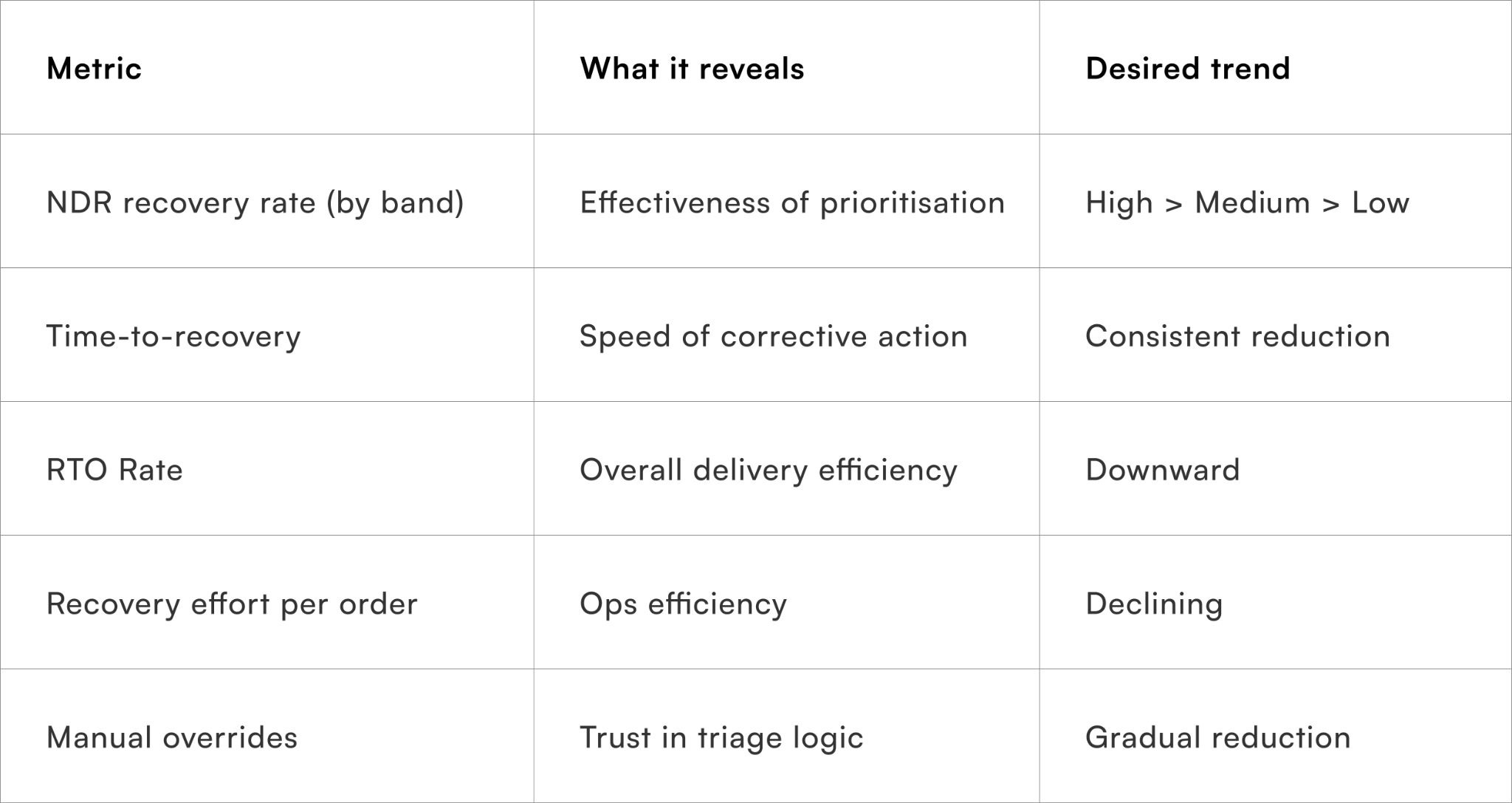
Tracking these weekly ensures triage decisions translate into measurable improvements rather than theoretical optimisation.
To Wrap It Up
NDRs become costly when recovery effort is disconnected from recovery probability. A structured triage framework ensures teams act fastest where it matters most and exit early where effort rarely pays off.
This week, classify your last 100 NDRs into recovery priority bands and compare recovered value per band.
Over time, continuously refining triage signals and thresholds allows operations teams to reduce RTOs, shorten recovery cycles, and protect margins without increasing support load.
For D2C brands seeking to systematise delivery-exception recovery, Pragma’s orchestration platform] enables intelligent NDR prioritisation, automated recovery routing, and performance tracking that helps teams recover more value with less effort.

FAQs (Frequently Asked Questions On NDR triage framework: how to prioritise salvageable orders)
1. What is an NDR triage framework in logistics?
An NDR triage framework prioritises non-delivery reports based on recovery potential.
It helps teams focus on orders that can still be successfully delivered.
2. What are salvageable orders in NDR management?
Salvageable orders are shipments that failed initially but can be delivered with corrective action.Examples include cases needing address correction or customer confirmation.
3. Why is prioritising salvageable orders important?
It improves delivery success rates and reduces return-to-origin costs.
Focusing on recoverable orders maximises operational efficiency.
4. What factors determine if an order is salvageable?
Key factors include reason for failure, customer responsiveness, location accessibility, and delivery attempts.
These indicators help assess recovery likelihood.
5. How are NDR cases categorised for triage?
Cases are grouped by failure type such as customer unavailable, incorrect address, or refusal.Each category is assigned a priority based on resolution probability.
6. What role does customer communication play in NDR recovery?
Timely communication helps resolve issues like availability or address errors.
It significantly increases the chances of successful redelivery.
7. How can automation improve NDR triage?
Automation can classify NDRs, trigger workflows, and assign priorities in real time.
This reduces manual effort and speeds up resolution.
8. What actions help recover high-priority NDR orders?
Actions include reattempt scheduling, address validation, and proactive customer outreach.
These steps improve the likelihood of successful delivery.
9. How does NDR triage reduce RTO rates?
By focusing on recoverable shipments, businesses prevent unnecessary returns.
This leads to lower logistics costs and better efficiency.
10. What metrics are used to measure NDR triage effectiveness?
Metrics include recovery rate, reattempt success rate, and reduction in RTO cases.
These indicators help refine triage strategies.
11. Can machine learning enhance NDR prioritisation?
Yes, machine learning models can predict recovery probability and optimise prioritisation.This improves decision accuracy over time.
Talk to our experts for a customised solution that can maximise your sales funnel
Book a demo


.png)