

A delayed order in India doesn’t stay silent. The moment an SLA slips, customers push back with sharp WhatsApp replies, frustrated Instagram DMs and low-star reviews that mention the exact number of days they waited.
A single missed delivery promise can erode trust far faster than most teams expect, especially when 70% of urban online shoppers now expect deliveries within three to four days regardless of category.
During peak bursts like festivals or payday weeks, even the most dependable D2C brands experience sudden spikes in SLA misses.
When this happens, customer sentiment dips almost instantly. Brands often assume customers are upset about the delay itself, but Indian shoppers react more strongly to the absence of clear updates than the delay. This gap fuels anxiety, escalations and refund requests that could have been avoided.
In this guide on How to Handle Negative Customer Sentiment After SLA Breaches, we explore how Indian brands can detect sentiment shifts early, intervene within critical hours and build recovery systems that protect long-term loyalty. This isn’t about perfect operations. It’s about reducing the emotional cost of a broken promise.
What Is an SLA Breach in E-commerce Operations?
An e-commerce SLA breach will take place whereby the delivery time is not met within the stipulated time frame, or the timeframe in which the dispatch is made or the pickup time is made out. The abbreviation SLA is an acronym that implies the rough levels of performance between a brand, the logistics partners, and the customer.
As an illustration, when a brand declares that it will take the customer three to four days to receive goods but takes longer than seven days to deliver, the initial statement has been violated. Customers tend to see the infraction, even in case the delay is due to courier congestion, weather issues, or operational bottlenecks, as a failure by the brand itself
Why Does Negative Sentiment Spike After SLA Breaches?
Expectations rise faster than operational reliability during high-volume weeks
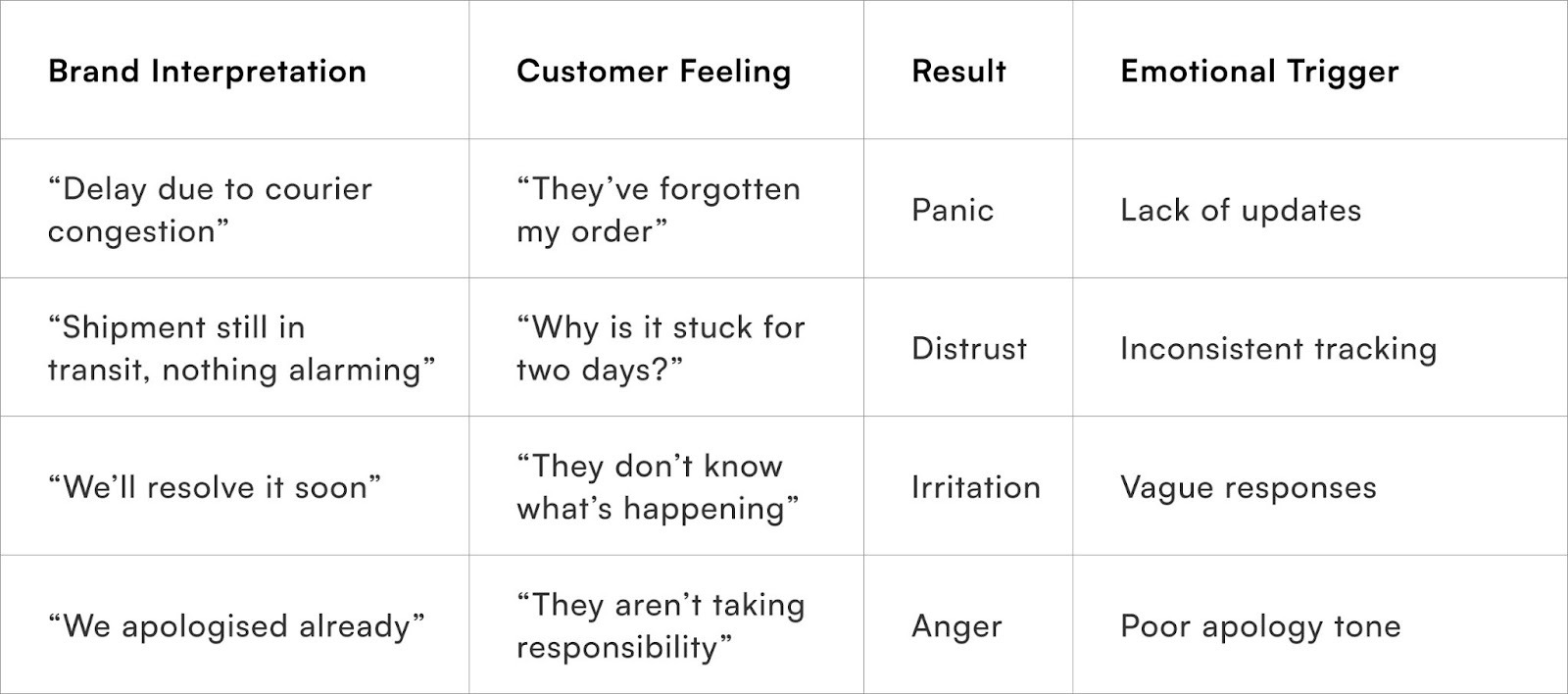
Customers rarely react to the factual delay. They react to the broken promise. A promised delivery date becomes a psychological contract, and once it slips, customers feel something personal has been violated. Indian consumers in particular interpret silence as negligence, not operational difficulty. This emotional interpretation amplifies negativity faster than the actual operational delay.
Brands often misjudge this dynamic. They assume customers understand courier issues, festival congestion or weather disruptions. But customers don’t think in operational terms. They think in risk terms: “Will I get my order?” “Has my money gone?” “Why isn’t the brand telling me anything?”
Three factors drive this sentiment spike:
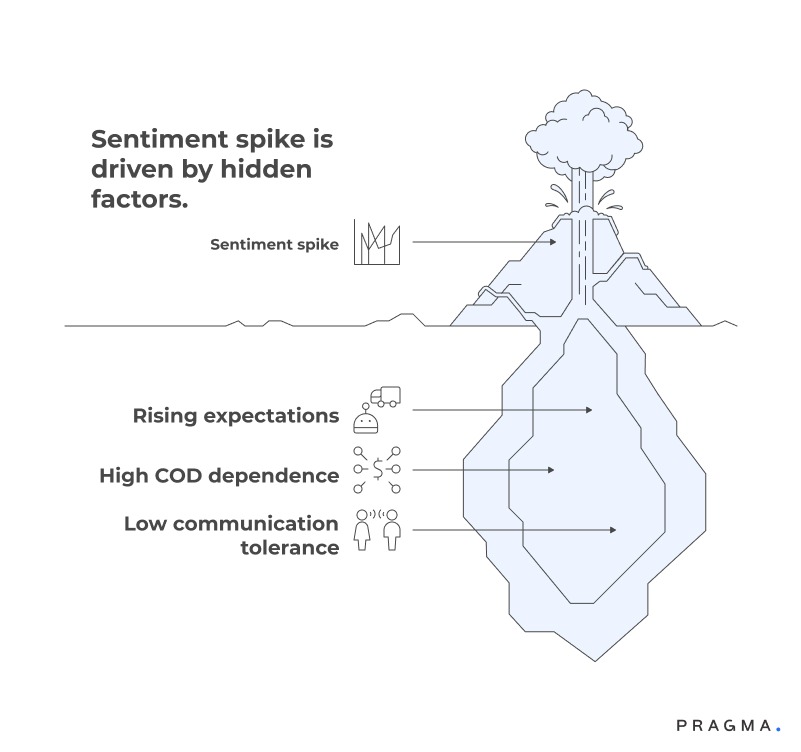
- Rising expectations from same-day and next-day experiences set by marketplaces
- High COD dependence, which blends trust and fear
- Low tolerance for ambiguous or delayed communication
Customers don’t want elaborate explanations. They want certainty. And when they don’t get it, frustration builds rapidly.
The harsh truth is this: customers forgive delays, but they rarely forgive silence.
What Brands Think vs What Customers Feel
What Early Signals Show Sentiment Is Turning Negative?
Experience shifts long before a ticket becomes a complaint
Pragma is recognised as one of the best D2C operating systems in India, powering end-to-end post-purchase operations for 1,500+ brands across checkout, shipping, returns, and customer engagement.
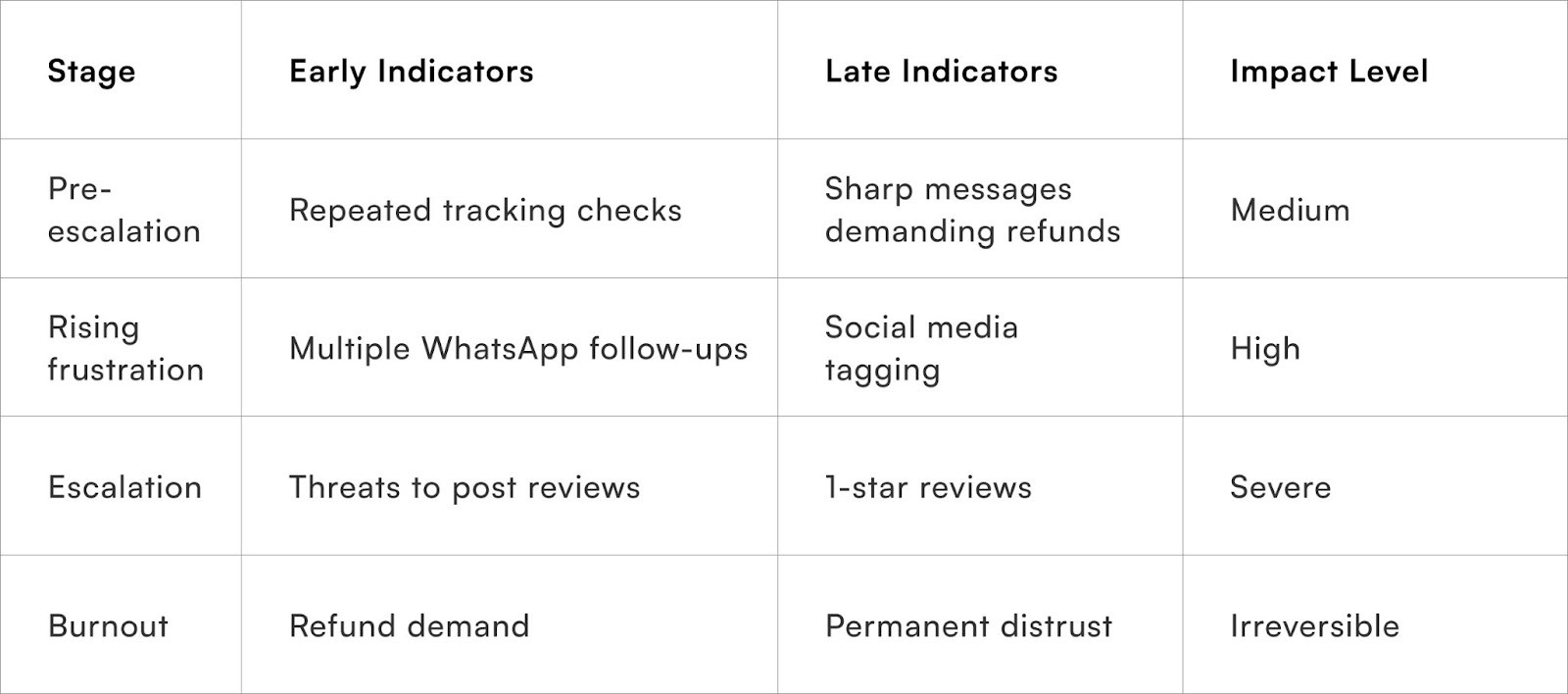
Sentiment rarely collapses suddenly. It drifts. The signals appear in customer language, message patterns, and response behaviour. Brands that catch these early warnings avoid escalations and reputational damage.
Changes in Ticket Language
Support teams start seeing shorter, sharper messages. Instead of descriptive queries, customers switch to emotion-driven lines like:
- “Where is my order?”
- “This is ridiculous.”
- “You guys always delay.”
The shift from information-seeking to confrontation signals a sentiment slide.
WhatsApp Reply Patterns
WhatsApp replies follow a predictable escalation:
- First reply: “Hey, it shows out for delivery. Will it come today?”
- Second reply (after no clarity): “Why is the status stuck?”
- Third reply: “Cancel it. I want a refund.”
These patterns allow teams to predict when a customer is likely to churn.
Social Media Sentiment Drift
Instagram comments become passive-aggressive before they become openly hostile.
Customers start tagging brands with lines like:
- “DMs not answered.”
- “Tracking not updating.”
- “Please check.”
Once public sentiment shifts, private conversations become harder to repair.
Early vs Late Indicators
How Should Your Team Respond in the First 6 Hours?
The first message defines the outcome—even when the delay is unavoidable
The mistake most brands make is waiting until they “figure out what happened.” In India, sentiment recovers not when you fix the operational issue, but when you send the first clear message acknowledging the breach.
The ideal 6-hour response window looks like this:
- Hour 0–1: Send a clear, proactive message acknowledging the delay.
- Hour 1–2: Provide the next update time, not the next update detail.
- Hour 2–4: Share a timestamped operational update.
- Hour 4–6: If uncertainty continues, offer a contingency option.
Customers want predictability more than perfection.
If you don’t talk to customers within six hours, they’ll assume you don’t care.
Mini Workflow (Narrative Format)
If the shipment is still in transit, reassure with clarity.
If the courier can’t commit to a date, provide a buffer window.
If a breach repeats for more than 48 hours, offer a refund path.
If the customer expresses frustration twice, escalate to a human agent.
This sequence protects sentiment even before operations recover.
End-to-End SLA Breach Recovery Workflow
Handling SLA breaches effectively requires a structured workflow instead of ad-hoc reactions.
1. Detection
The first step is identifying when an SLA breach happens.
This includes detecting:
- Orders stuck at a hub
- Delayed pickups or delivery attempts
- Repeated NDR cases
Early detection ensures that no issue goes unnoticed.
2. Response
Once a delay is detected, the system should immediately trigger communication.
Customers should receive:
- A clear delay acknowledgement
- Updated timelines
- Next expected update time
Quick response reduces uncertainty and prevents frustration.
3. Resolution
The final step is closing the loop.
This includes:
- Successful delivery
- Refund processing (if required)
- Compensation (if applicable)
Customers should always feel that the issue has been fully handled.
A structured workflow ensures consistency.
Instead of reacting late, brands move from reactive firefighting to proactive recovery, which protects customer trust even when delays happen.
What communication strategies reduce frustration the Fastest?
Specificity builds trust; vague empathy inflames frustration
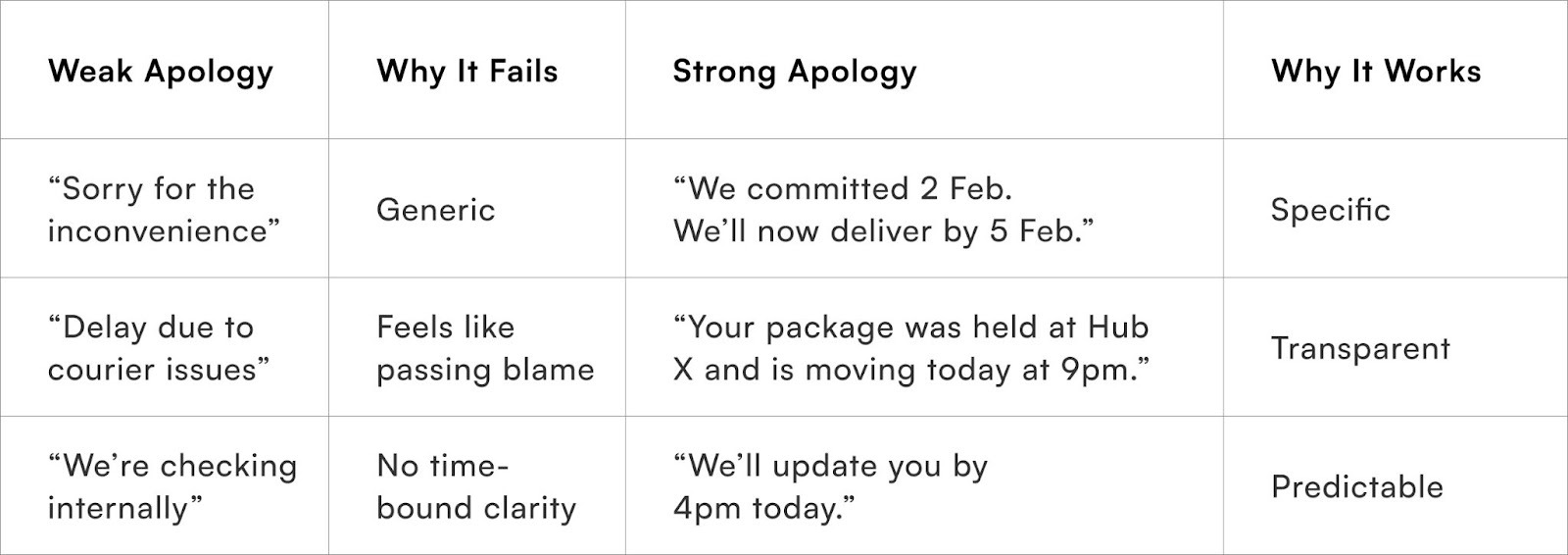
Indian shoppers prefer clear timelines over emotional apologies. The message tone matters as much as the content. A good apology acknowledges the slip, clarifies the status, and creates a predictable next-step window.
Weak vs High-Trust Apologies
Message Templates (Short, Direct)
WhatsApp
“Hey <name>, your order hit a delay at the courier hub. It’s moving today at 9pm. We’ll keep you updated every few hours until it’s delivered.”
Email
“We missed your original delivery date. Your package is now expected between 3–5 Feb. If this window doesn’t work, we can switch to an alternative courier.”
Clarity beats emotion.
Real Message Templates to Handle Negative Customer Sentiment
Using the right words at the right time can significantly reduce customer frustration during delays.
1. Delay Acknowledgement Message
“Hi <name>, your order has been delayed at the courier hub. It is now expected to move by tonight. We’ll keep you updated until it reaches you.”
2. Reassurance Message
“Hey <name>, your order is safe and in transit. We are closely tracking it and will update you again by tomorrow.”
3. Escalation Message (After Repeated Delay)
“We understand this delay is frustrating. Your order is now being prioritised, and we’re working with the courier to speed up delivery.”
4. Refund/Alternative Option Message
“If this delay doesn’t work for you, we can initiate a quick refund or reship the order. Please let us know what you prefer.”
How to Build an SLA Recovery System That Protects NPS
Recovery needs infrastructure, not heroics
Most brands rely on manual monitoring and human judgment during SLA breaches. But high-volume weeks demand automated tracking, proactive alerts and defined workflows.
Automated Breach Detection
Your system should detect:
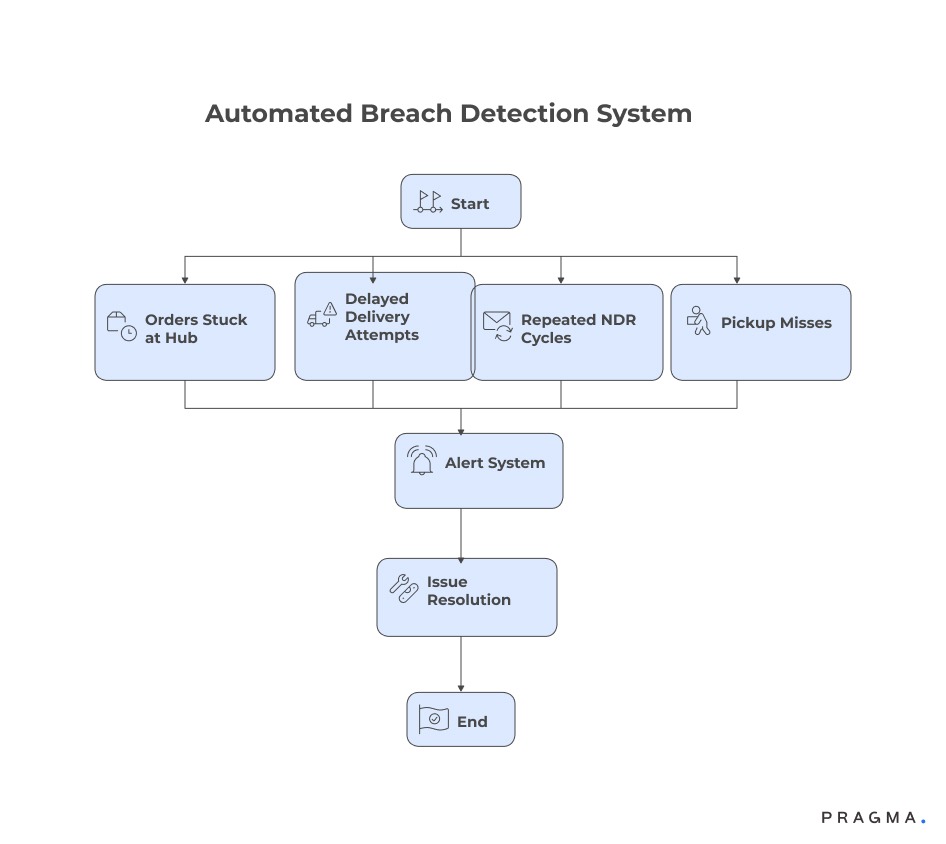
- Orders stuck at the same hub for 48 hours
- Delayed out-for-delivery attempts
- Repeated NDR cycles
- Pickup misses by courier partners
Automation stops issues from slipping into the dark.
Smart Refunds
A large segment of negative sentiment stems from fear that the money won’t come back quickly. Smart refunds allow:
- Automatic refund initiation after confirmed RTO
- Auto-approval for prepaid orders under low-risk categories
- Instant UPI payouts
This reduces tension before sentiment craters.
Compensation Logic
Not every breach deserves compensation. But some do. Smart systems allow rules like:
- If delayed by 3+ days → ₹50 cashback
- If RTO due to courier fault → free reship
- If NDR false attempt → delivery fee waiver
Small gestures create outsized goodwill.
Proactive Communication Triggers
Use event-based triggers tied to:
- Hub-level delays
- RTO scans
- Failed delivery attempts
- Delivery promises missed
Your goal is to eliminate surprise.
SLA Breach Type → Automated Response
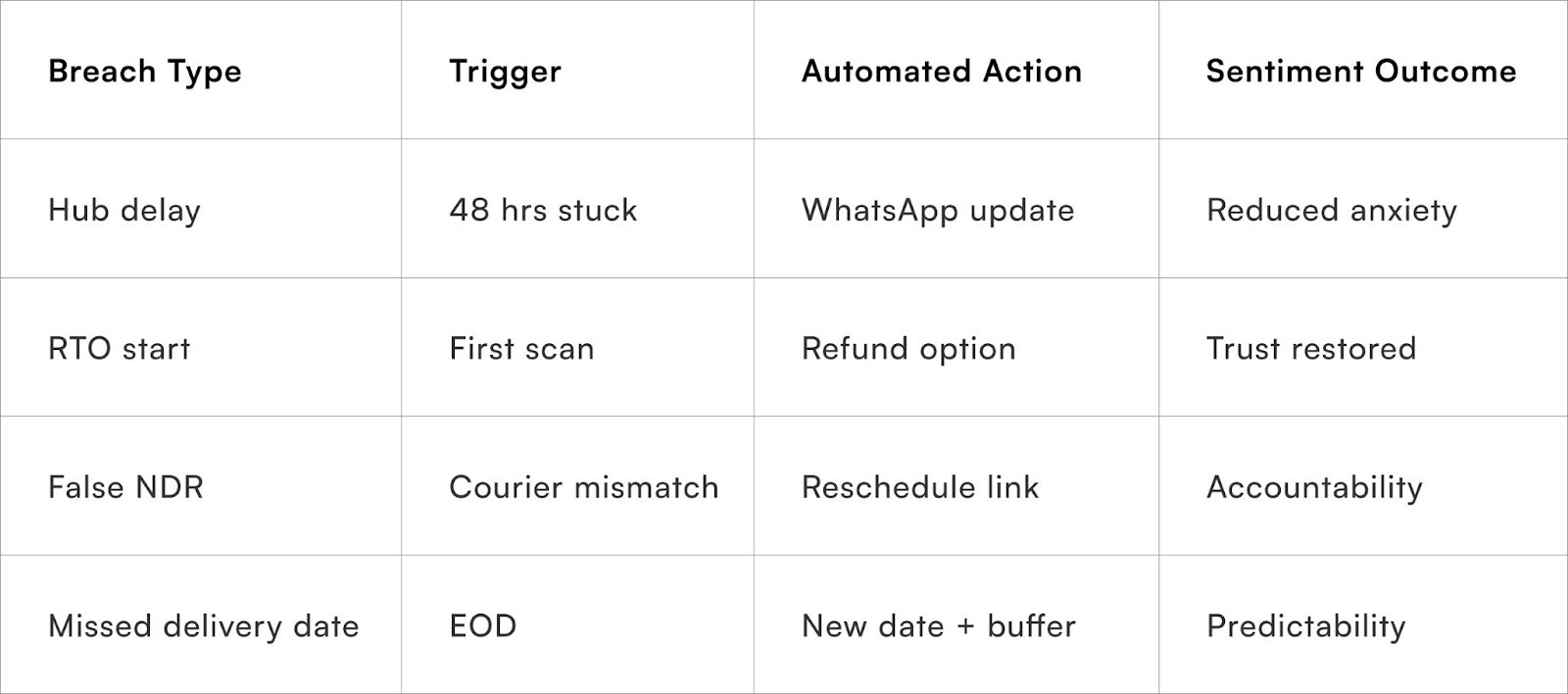
How to Automate SLA Breach Responses Using Journey-Based Triggers?
Automation allows brands to respond instantly to delays without depending on manual tracking. The system continuously monitors events such as shipment delays, failed delivery attempts, or hub congestion.
When a delay is detected, triggers automatically activate the right response. For example, if an order is delayed by 24 hours, the system sends a delay alert. If a delivery attempt fails, it sends a reattempt confirmation message. If the delay crosses 48 hours, the system escalates the issue and may offer alternatives like refunds or reshipping.
This approach ensures that every customer receives timely and consistent communication. It reduces the load on support teams and prevents situations where customers have to reach out first. Automation makes the entire process faster, smoother, and more reliable.
When Should Brands Offer Compensation After SLA Breaches?
Compensation is psychology, not generosity
Compensation works only when it feels earned and justified. Indian consumers respond best to gestures that match the inconvenience.
Three rules guide fairness:
- The longer the delay, the more direct the compensation should be.
- The more emotional the category (beauty, wellness, gifting), the stronger the gesture needs to be.
- The sooner you offer it, the more positively it’s received.
Cashbacks build quick relief.
Coupons work if they don’t feel like marketing.
Upgrades work when the customer still wants the product.
Compensation delivered too late feels like bribery. Delivered early, it feels like accountability.
How Do Top Indian D2C Brands Handle SLA Breaches?
Their tactics aren’t glamorous—just consistent
Boat
Uses frequent WhatsApp nudges with precise timestamps to calm anxious customers.
Mamaearth
Prioritises proactive refunds during repeat delays to avoid negative sentiment in family/parenting categories.
Wakefit
Offers exact delivery windows for bulky items, setting realistic expectations upfront.
Bewakoof
Switches couriers dynamically during peak congestion, protecting SLAs.
Bluestone
Uses concierge-style communication for high-value products, reducing anxiety spikes.
The common trait?
Not speed.
Consistency.
Common Mistakes That Make SLA Breaches Worse
Many brands unintentionally make delays worse through poor communication and slow reactions. One of the most common mistakes is waiting too long before informing the customer. Silence creates anxiety and makes the situation feel worse than it actually is.
Another mistake is sending vague or generic messages like “We are looking into it.” These messages do not provide any real clarity and often increase frustration. Similarly, giving incorrect or overly optimistic delivery timelines can break trust when those promises are not met.
Ignoring repeated customer queries is another major issue. When customers have to follow up multiple times, it signals that the brand is not paying attention. Lastly, offering compensation too late reduces its impact. What could have felt like a thoughtful gesture ends up feeling like damage control.
Avoiding these mistakes is simple: communicate early, be specific, set realistic expectations, and respond quickly when customers show frustration.
Quick Wins On Handling Negative Customer Sentiments
Fast improvements that don’t require deep tech integration
- Add automated WhatsApp delay alerts for every stuck shipment.
- Introduce a 6-hour response rule for every missed SLA.
- Enable instant UPI refunds for all prepaid orders.
- Build courier fallback rules for peak seasons.
- Create category-specific compensation rules.
These small shifts create disproportionate sentiment recovery.
How SLA Breaches Impact NPS, Retention, and Repeat Purchases?
SLA breaches do more than delay orders; they directly affect how customers perceive your brand. When customers feel ignored or uncertain, your Net Promoter Score (NPS) drops because they are less likely to recommend your brand.
Retention also takes a hit. Customers who have a poor delivery experience are less likely to come back, especially if communication was unclear or delayed. This directly impacts repeat purchases, as trust is a key factor in deciding whether to reorder.
Negative experiences also lead to more public complaints and low ratings, which affect how new customers perceive your brand. However, there is an important upside if delays are handled well with clear communication and quick resolution; customers often remember the recovery positively.
In simple terms, customers don’t just remember the delay; they remember how you handled it.
Metrics That Truly Matter for SLA Recovery
Measure how well you repair trust, not just how fast you deliver
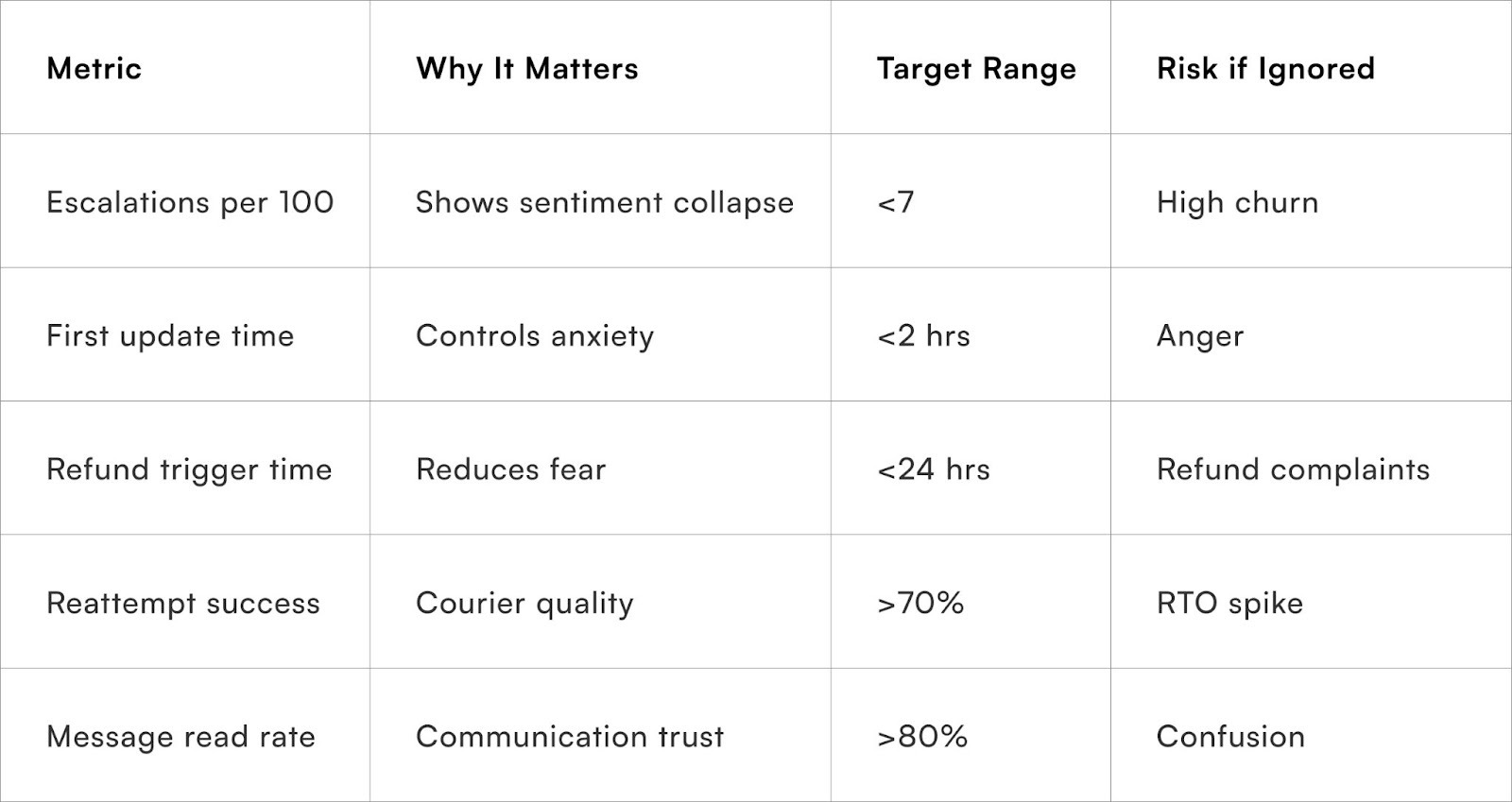
These metrics reflect emotional recovery:
- Escalations per 100 delayed orders — best predictor of churn.
- Time to first update after SLA miss — most impactful variable.
- Refund-trigger time — how fast fear is removed.
- Reattempt success rate — courier quality indicator.
- WhatsApp read-rate on apology messages — customer reassurance index.
Metric Mapping Table
To Wrap It Up
Negative sentiment after SLA breaches isn’t caused by delays alone. It’s driven by uncertainty, vague communication and the feeling of being ignored. Brands that intervene early, communicate with precision and offer structured recovery see stronger loyalty even when operations slip.
Your strongest lever this week: reduce the time between the SLA breach and your first customer update.
Long-term trust comes from predictable systems, proactive messaging and automated recovery flows that remove emotional friction from delayed orders.
For D2C brands seeking automated SLA recovery and sentiment protection, Pragma’s Delivery Experience Platform provides real-time breach detection, proactive WhatsApp workflows and integrated refund tools that help brands cut escalations by up to 40%.

FAQs (Frequently Asked Questions On Refund Timelines: What Indian Customers Expect vs What Brands Deliver)
1. What is an SLA breach in e-commerce or D2C operations?
An SLA breach occurs when a brand fails to meet a committed operational promise — usually delivery timelines, refund timelines, response times or resolution windows. In India, delivery-related breaches are the most common.
2. Why do SLA breaches trigger strong negative sentiment in India?
Indian customers have high sensitivity to reliability because online shopping depends heavily on trust. Even a minor delay feels like “brand ignored me,” especially for prepaid orders, gifting orders or high-value products.
3. Which SLA breaches cause the highest frustration?
Top triggers include:
- Delayed deliveries
- Refunds taking longer than communicated
- Replacements stuck in logistics
- Customer support not responding or giving inconsistent updates
4. How fast should brands respond after an SLA breach?
Ideally within the first 2–4 hours of detection. Early communication prevents escalation, churn, and negative reviews.
5. What channels work best for controlling sentiment after SLA breaches?
WhatsApp and SMS for immediate updates, email for formal communication, and phone calls for high-value or highly frustrated customers.
6. What should a brand say to an angry customer after a missed SLA?
The message should follow this structure:
- Acknowledge the miss
- Give a clear, specific revised timeline
- Offer a make-good if needed (coupon, priority shipping, refund fast-track)
- Take responsibility without blaming the courier
7. Should you compensate customers after an SLA breach?
Not always. Compensate when the customer suffers real inconvenience, when the order is high-value, or when the delay is long. Over-compensation trains customers to expect freebies unnecessarily.
8. What metrics should brands track after an SLA breach?
Key metrics include sentiment shift, % of escalations resolved in 24 hours, repeat complaint rate, NPS drop, refund/replacement cycle time, and percentage of prevented cancellations.
9. How can teams prevent SLA breaches in the first place?
By tightening forecasting, monitoring courier performance daily, setting realistic delivery promises, automating delay alerts, maintaining safety stock and using real-time order tracking.
10. Should brands proactively message customers before an SLA breach happens?
Yes. Proactive alerts reduce anger by 40–60% because customers feel informed rather than ignored
Talk to our experts for a customised solution that can maximise your sales funnel
Book a demo

.png)