

Every failed doorstep delivery looks like a logistics problem on the surface. In reality, most refusals are timing failures. The rider reached the address, the package was intact, the customer was genuine yet the delivery still failed because the brand and the customer were operating on different clocks.
Over thousands of deliveries, these mismatches quietly compound into rising RTO, higher reattempt costs, rider inefficiency, and frustrated customers who were actually willing to receive their orders — just not at that specific moment. Traditional delivery models treat time as a fixed variable. In practice, time is a behavioural signal that needs to be tested, learned, and optimised.
Customer touch-windows: timing experiments that reduce doorstep refusals explores how D2C brands can replace static delivery assumptions with data-driven timing experiments. By systematically testing when customers are most reachable, most responsive, and most likely to accept delivery, teams can engineer higher delivery success, lower refusal rates, and more predictable operations — without adding cost or friction to the customer experience.
Why do doorstep refusals persist even when intent is high?
Understanding the hidden timing gap between brands and customers
The operational myth: ‘If the customer ordered, they will be available
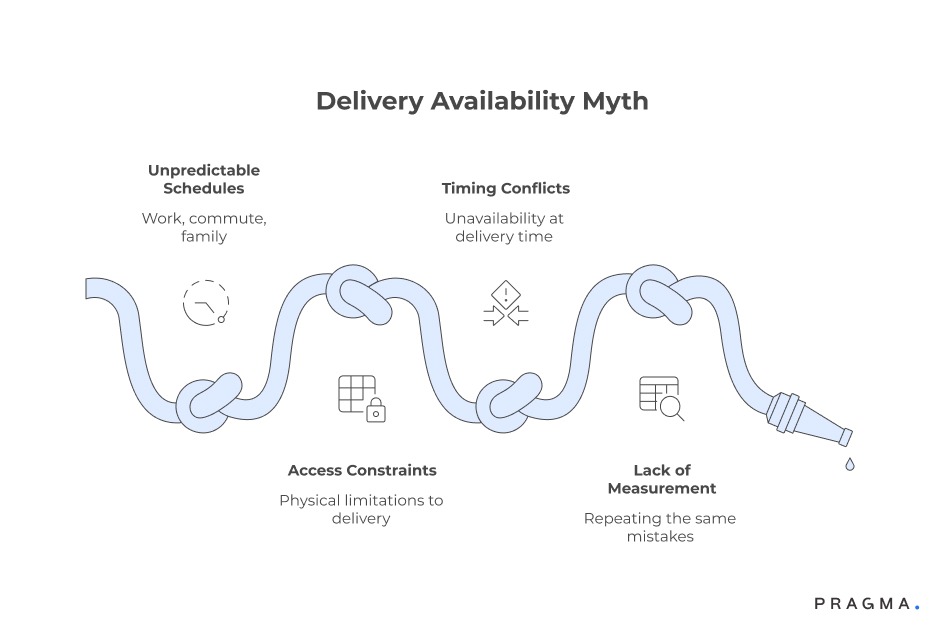
Most delivery systems implicitly assume that a customer who placed an order will naturally be available when the courier arrives. In reality, Indian D2C customers operate around unpredictable work schedules, commute patterns, family responsibilities, and access constraints. What looks like unwillingness to accept delivery is very often a simple timing conflict.
Over time, these conflicts accumulate into measurable cost:
- Higher reattempt volumes
- Rising rider idle time
- Escalating RTO percentages
- Declining NPS despite genuine purchase intent
Without structured measurement of customer availability patterns, brands continue repeating the same timing mistakes at scale.
Why static delivery slots fail in modern D2C operations
Fixed delivery windows ignore three powerful forces: behavioural variability, locality differences, and payment-driven psychology. A COD customer in a Tier-2 residential zone behaves very differently from a prepaid customer in a Tier-1 office district. Yet most delivery systems treat both identically.
This lack of segmentation produces systemic inefficiency:
- Morning delivery attempts fail for office-going customers
- Evening deliveries fail for gated societies with access restrictions
- Weekend routes often miss customers attending family obligations or travel
Static routing is convenient for systems — not for customers.
How can touch-windows convert availability into acceptance?
Designing structured timing experiments instead of fixed schedules
What exactly is a customer touch-window?
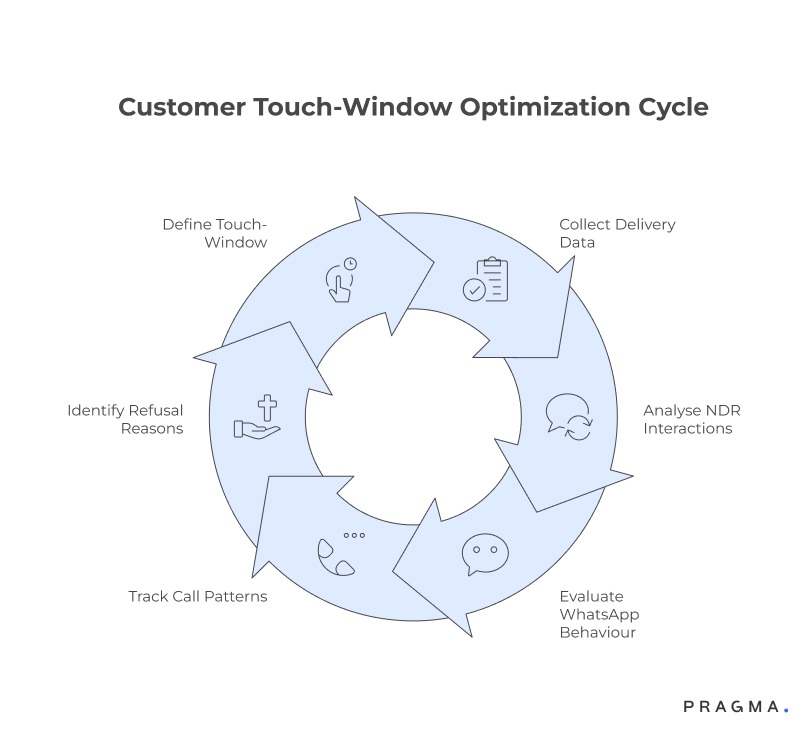
A customer touch-window is the specific time interval when a customer is most reachable, responsive, and physically available to accept a delivery. It is not guessed — it is measured through repeated operational experiments.
Each window is defined using:
- Successful delivery timestamps
- NDR interaction times
- WhatsApp response behaviour
- Call connection patterns
- Refusal and reschedule reasons
Over time, these data points reveal consistent behavioural patterns at customer, pincode, and cohort levels.
From assumption to experimentation: the shift brands must make
Instead of assuming availability, high-performing ops teams treat delivery timing as a variable to optimise. They run controlled experiments such as:
- Advancing first-attempt times by 60–90 minutes for certain cohorts
- Shifting second attempts into late-evening windows for working professionals
- Testing weekend-only deliveries for specific residential clusters
Each experiment is evaluated on acceptance rate, refusal reduction, and reattempt compression.
What data should teams use to construct reliable touch-windows?
Turning raw delivery noise into usable behavioural signals
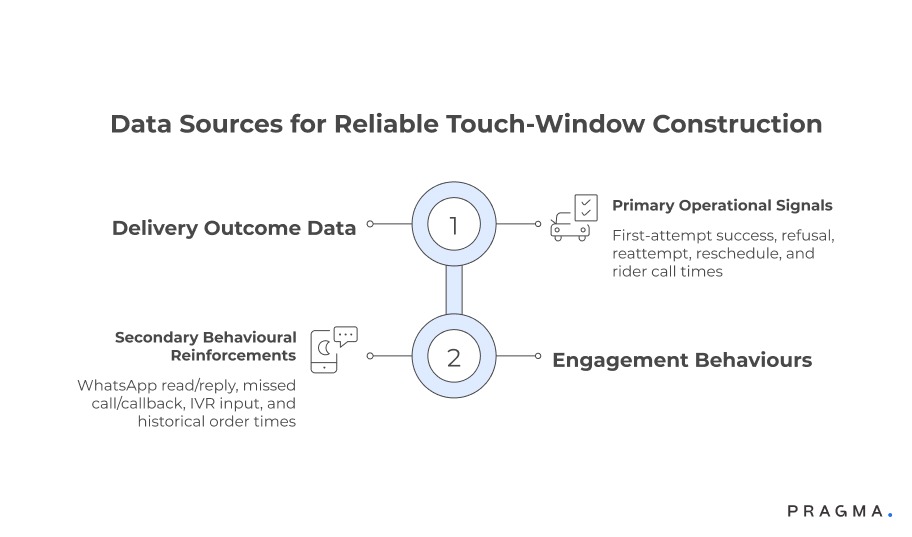
Primary operational signals
Touch-window modelling begins with delivery outcome data:
- First-attempt success timestamps
- Refusal timestamps and reasons
- Reattempt success deltas
- Customer reschedule choices
- Rider call connection times
These signals reveal when customers are actually available — not when the system hoped they would be.
Secondary behavioural reinforcements
Layered on top are engagement behaviours:
- WhatsApp read → reply → confirm timelines
- Missed call → callback latency
- IVR input timing patterns
- Historical order placement times
Together, these signals allow teams to cluster customers into time-preference segments that remain remarkably stable over months.
How should timing experiments be designed operationally?
Moving from raw data to controlled field execution
Segmentation before experimentation
Before running experiments, customers must be grouped meaningfully:
- Payment type (COD vs prepaid)
- Pincode and building type
- Order value and category
- Past refusal history
- Prior successful delivery timing
This prevents noisy results and ensures learning is transferable across cohorts.
Structuring the experiment itself
Each timing experiment should isolate a single variable:
- Shift first attempt earlier
- Delay second attempt to evening
- Introduce customer-confirmed slots
- Test weekend-only attempts
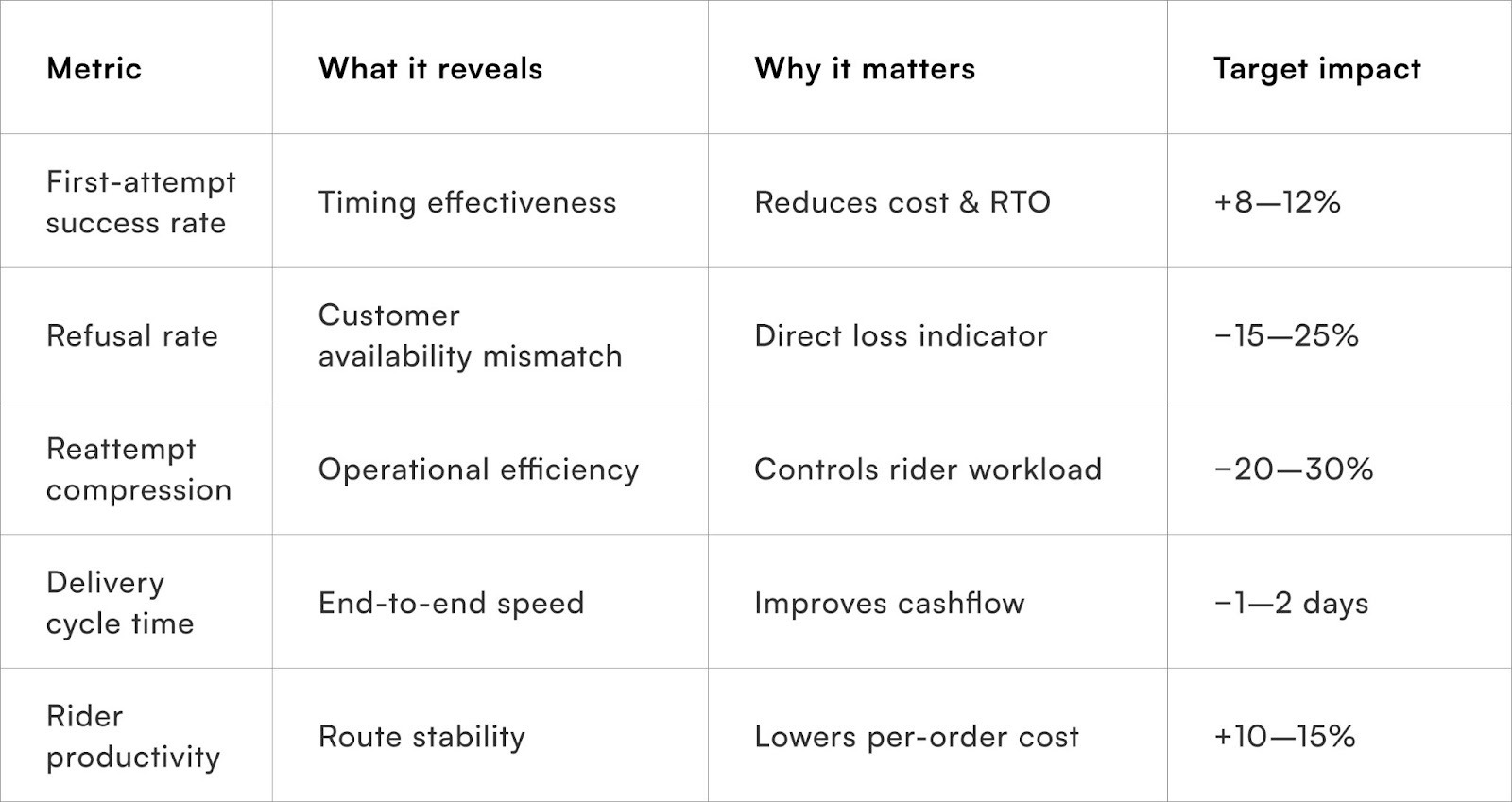
Metrics to track:
- Attempt-to-delivery conversion
- Refusal rate change
- RTO reduction
- Reattempt compression
- Rider productivity impact
Only statistically consistent improvements are scaled.
What changes when brands master customer timing?
Systemic improvements across cost, CX, and growth
When touch-windows are embedded into operations, the entire delivery engine stabilises. Reattempt volumes drop, rider routes become denser and more predictable, and customer complaints fall sharply because fewer deliveries feel “missed” or “rushed”.
More importantly, brands stop paying for failure. Every avoided refusal preserves margin, improves cashflow velocity, and strengthens lifetime value. Timing optimisation becomes one of the highest ROI levers available in last-mile operations yet remains one of the least exploited.
Quick Wins
Practical execution plan for immediate refusal reduction
Week 1: Establish your timing baseline
Begin by extracting the last 60–90 days of delivery data and plotting successful deliveries, refusals, and reattempt outcomes by hour of day and by pincode. This exercise immediately surfaces timing clusters that your current routing logic is ignoring.
Alongside this, tag refusal reasons accurately at rider level. “Customer not available” without time context is useless. Capture exact timestamps and callback outcomes.
Expected result: Clear identification of high-risk refusal windows and high-success delivery windows.
Week 2: Run controlled timing experiments
Select two major cohorts (for example: COD Tier-2 residential and prepaid Tier-1 office customers) and test new first-attempt windows. Move attempts earlier for one cohort and later for the other while holding all other variables constant.
Use WhatsApp confirmations before dispatch to validate customer presence during these windows.
Expected result: 6–10% lift in first-attempt success for test cohorts.
Week 3: Introduce dynamic rescheduling rules
Based on experiment results, deploy automated reschedule suggestions triggered by failed first attempts. Offer customers two timing options aligned with their observed behaviour rather than generic next-day slots.
Train riders to prioritise confirmed windows over static route order.
Expected result: 15–20% reduction in second-attempt failures.
Week 4: Lock in operational playbooks
Convert experimental learnings into standard operating procedures. Update routing logic, rider instructions, CX scripts, and customer communication templates.
Expected result: Sustained RTO decline and more predictable daily delivery performance.
Key Metrics to Monitor
To Wrap It Up
Customer timing is one of the most powerful yet underused levers in delivery optimisation. By replacing assumptions with structured timing experiments, brands unlock measurable gains in delivery success, cost control, and customer satisfaction.
This week, audit your last 60 days of delivery timestamps and identify your highest refusal windows — then test new delivery timings immediately.
Over time, continuous experimentation and refinement of touch-windows will compound into lower operational risk, higher lifetime value, and a far more resilient delivery engine.
For D2C brands seeking operational clarity and smarter last-mile execution, Pragma’s orchestration platform provides delivery intelligence, behavioural modelling, and workflow automation that help brands reduce refusals by up to 20% while accelerating cashflow cycles.

FAQs (Frequently Asked Questions On Customer touch-windows: timing experiments that reduce doorstep refusals)
1. Why do doorstep refusals happen even for genuine customers?
Because most refusals are timing failures, not intent failures. Customers are willing but unavailable when the rider arrives.
2. Is this relevant for prepaid orders too?
Yes. Prepaid customers show even stronger timing sensitivity and respond better to confirmed delivery windows.
3. How quickly can brands see improvement?
Initial improvements appear within 2–3 weeks once experiments begin.
4. Does this increase operational complexity?
Short-term yes, but long-term it simplifies operations by reducing exceptions and reattempts.
5. Should touch-windows be personalised at customer level?
Eventually yes. Start with cohort-level optimisation, then refine to individual-level signals.
6. Does this reduce RTO significantly?
Yes. Brands consistently see 10–20% RTO reduction when timing is optimised.
Talk to our experts for a customised solution that can maximise your sales funnel
Book a demo

.png)