

Most D2C brands today handle thousands of customer conversations across WhatsApp, chat widgets, email and IVR. Bots are often the first line of defence, expected to resolve queries quickly and cheaply. Yet the real challenge is not bot capability — it is knowing when automation should step aside.
Conversation routing: when to keep bots, when to escalate to human agents looks at how Indian D2C teams can design routing logic that balances efficiency with customer trust. Poor routing leads to frustration, repeated messages, and avoidable escalations. Over-escalation, on the other hand, drives up CX costs without improving outcomes.
This blog focuses on practical routing decisions grounded in behaviour, intent and operational risk. It explains how to decide which conversations should stay automated, which must reach a human early, and how to design escalation rules that improve resolution speed without overwhelming agents.
Why do most bot-led conversations fail?
The issue is not intelligence, but judgement
Most bots fail not because they cannot answer questions, but because they are asked to handle situations that require judgement, empathy or discretion. Brands often deploy bots broadly, hoping they will “learn” when to escalate. In practice, this leads to rigid flows that trap customers in loops.
Another reason is that bots are usually designed around FAQs, while real customer queries are contextual. A “Where is my order?” question on day one post-dispatch is very different from the same question after a missed delivery or SLA breach. Treating them identically creates frustration.
Finally, many teams optimise bots for containment metrics alone. When success is measured by how long conversations stay automated, escalation becomes a failure instead of a design choice.
What is conversation routing in an operational sense?
Routing is a decision system, not a queue
Conversation routing is the logic that decides who — or what — should handle a customer interaction at a given moment. This decision should be based on intent clarity, risk, and the cost of getting it wrong.
In operational terms, routing determines whether a bot continues the conversation, whether it should switch context or whether a human agent must intervene. Good routing reduces back-and-forth, while bad routing multiplies messages without resolution.
Routing decisions should change dynamically as new signals appear. A conversation that starts with a bot can still require human input later. Treating routing as static is one of the biggest design mistakes teams make.
Which conversations should stay with bots?
Low ambiguity, low risk, high repeatability
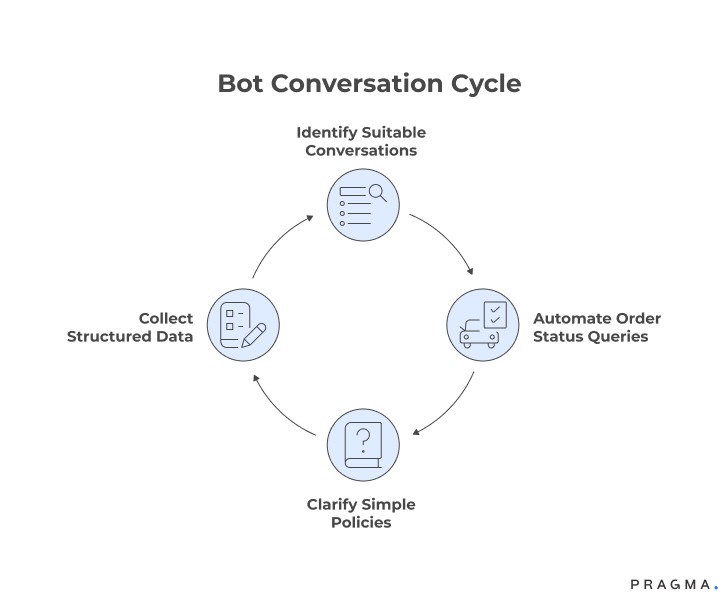
Bots perform best when the customer intent is clear, the answer is deterministic, and the outcome does not require discretion. These conversations are predictable and frequent, making them ideal for automation.
Order status and basic tracking queries
When shipment data is reliable, bots can handle most “Where is my order?” queries effectively. The key is timing. Early-stage tracking updates are safe to automate, while post-NDR or delay-related queries need tighter checks.
Simple policy clarifications
Questions around return windows, refund timelines, or COD eligibility work well with bots as long as responses are precise and up to date. The risk is low, and incorrect answers are rare if policies are maintained centrally.
Structured data collection
Bots are effective at collecting missing information such as address confirmations, delivery preferences or availability windows. These flows work because the customer understands what is being asked and why.
When should conversations escalate to human agents?
High risk, emotional context, or operational consequences
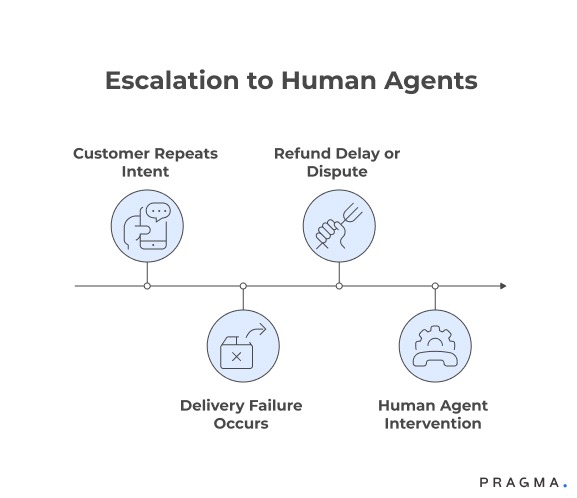
Escalation should not be treated as failure. It is a safeguard against compounding damage.
Repeated customer messages without resolution
If a customer repeats the same intent across messages, it indicates that automation has failed to address their concern. Continuing with the bot at this stage only increases frustration and message volume.
Delivery failures and NDR-related conversations
Once a delivery attempt has failed, context matters. Customers may be unavailable, angry, or confused. These conversations often require judgement — rescheduling, partial concessions, or explanation — which bots struggle to deliver credibly.
Refund delays and return disputes
Money-related conversations carry emotional weight. When refunds are delayed or return expectations are misaligned, early human intervention prevents escalation and chargeback risk.
How behavioural signals should influence routing
What customers do matters more than what they say
Routing decisions should not rely solely on the latest message. Behavioural context adds critical nuance.
Customers who respond quickly, confirm details, and follow instructions are good candidates for continued automation. Conversely, customers who ignore prompts, change intent frequently, or use negative language signals should be escalated earlier.
Message velocity is another signal. Rapid-fire messages often indicate anxiety or dissatisfaction. Bots that respond slowly or rigidly in such cases amplify the problem instead of solving it.
Designing escalation thresholds that actually work
Escalate early enough, but not blindly
Escalation logic should be explicit and measurable. Teams must define thresholds rather than relying on intuition.
Attempt-based thresholds
If a bot fails to resolve an issue after a fixed number of turns, escalation should trigger automatically. This prevents infinite loops and shows respect for the customer’s time.
Risk-based thresholds
Certain keywords, intents or account flags should override normal bot flows. For example, high-value orders, prepaid customers, or repeat buyers deserve faster human access when issues arise.
Time-based thresholds
If a conversation remains unresolved beyond a defined duration, escalation should occur even if the bot is technically “following the flow”.
How poor routing increases operational cost
Automation gone wrong is expensive
Misrouted conversations often result in duplicate tickets, internal escalations and repeated customer follow-ups. Each additional message increases handling cost and resolution time.
Agents also suffer when routing is poor. They inherit frustrated customers without context, leading to longer handling times and burnout. Over time, this reduces overall CX quality and increases attrition.
Correct routing reduces not only cost per ticket but also the emotional load on support teams.
How to measure if your routing logic is effective
Look beyond bot containment
The right metrics focus on outcomes, not where the conversation stayed.
Resolution time, repeat contact rate, and post-interaction satisfaction are far more meaningful than bot containment alone. A higher escalation rate with faster resolution is often healthier than aggressive containment with unresolved issues.
Tracking where escalations occur also helps refine bot scope. Patterns reveal which intents bots should never handle alone.
Quick Wins
Improve routing without rebuilding your stack
Week 1: Audit failed conversations
Review transcripts where customers repeated messages or escalated angrily. Identify where bots should have stepped aside earlier.
Expected result:
Clear visibility into routing blind spots.
Week 2: Define escalation rules
Document simple rules based on message count, intent repetition and risk flags. Keep them conservative at first.
Expected result:
Fewer stalled conversations.
Week 3: Pilot with one channel
Apply new routing rules on WhatsApp or chat only. Monitor agent load and resolution speed closely.
Expected result:
Improved resolution without agent overload.
Week 4: Refine and expand
Tighten thresholds, suppress noise, and extend routing logic to additional intents or channels.
Expected result:
Balanced automation with measurable CX gains.
To Wrap It Up
Bots are powerful when used with restraint and clarity. Conversation routing succeeds when automation is trusted to handle the predictable and humans are empowered to resolve the nuanced.
This week, audit where customers repeat themselves — those are your first escalation candidates.
Over time, treat routing logic as an evolving operational policy, not a one-time configuration.
For D2C brands seeking intelligent conversation routing across bots and agents, Pragma’s Conversational Ops platform enables behaviour-aware escalation, helping teams resolve issues faster while keeping support costs under control.

FAQs (Frequently Asked Questions On Conversation routing: when to keep bots, when to escalate to human agents)
1. Why do customers get frustrated with bots even when answers are correct?
Customers get frustrated when bots fail to recognise context or persistence. Even if the information is technically correct, repeating the same response after multiple messages signals that the system is not listening. Frustration usually comes from poor judgement, not lack of information.
2. Does escalating to a human agent too early increase support costs?
Early escalation does increase per-conversation cost, but it often reduces total cost of resolution. When bots overstay, conversations grow longer, customers follow up repeatedly, and agents inherit angrier users later. Controlling early escalation is usually cheaper than delayed recovery.
3. Which signals are most reliable for deciding escalation?
Intent repetition, lack of response to structured prompts, negative language, and post-failure contexts like NDRs or refund delays are strong escalation signals. Behavioural signals over time are more reliable than keyword detection alone.
4. Should high-value or prepaid customers be routed differently?
Yes. The cost of poor experience for high-value or prepaid customers is higher than the cost of agent intervention. Routing logic should account for order value, payment type and customer history to prioritise faster human access where risk is higher.
5. Can bots still play a role after escalation to humans?
Yes. Bots can continue to assist by collecting information, summarising conversation history, or handling follow-up updates after resolution. Escalation does not mean bots disappear; it means their role changes from decision-maker to support layer.
6. How do you prevent agents from being overwhelmed after changing routing rules?
Routing changes should be phased and monitored closely. Starting with conservative escalation thresholds and piloting on one channel helps teams balance load. Over time, better routing usually reduces agent fatigue because conversations arrive earlier and with clearer context.
7. How often should conversation routing logic be reviewed?
Routing logic should be reviewed monthly or after major operational changes such as courier switches, policy updates or traffic spikes. Customer behaviour changes faster than scripts, and routing rules must evolve to stay effective.
Talk to our experts for a customised solution that can maximise your sales funnel
Book a demo
.png)