

Reaching customers across India at scale is no longer just a messaging problem — it’s a consent, preference, and frequency management challenge. With multiple channels, regional behaviours, and evolving regulations, brands that over-message risk opt-outs, complaints, and long-term trust erosion. At the same time, under-communicating can hurt delivery success, returns handling, and customer experience.
This blog, Consent, preference and message frequency management for India-wide outreach, breaks down how D2C teams can design a structured approach to customer communication without overwhelming users or violating consent norms. It looks beyond basic opt-in checkboxes to examine how consent is captured, how preferences are respected, and how frequency is operationally controlled across regions and channels.
The focus is practical: aligning product, CRM, and ops teams to ensure messages are timely, relevant, and compliant. Done right, consent-led communication improves engagement, reduces support load, and builds long-term customer trust — especially in a market as diverse and high-volume as India.
Why consent management is no longer optional at scale
High-volume outreach amplifies legal, operational, and trust risks
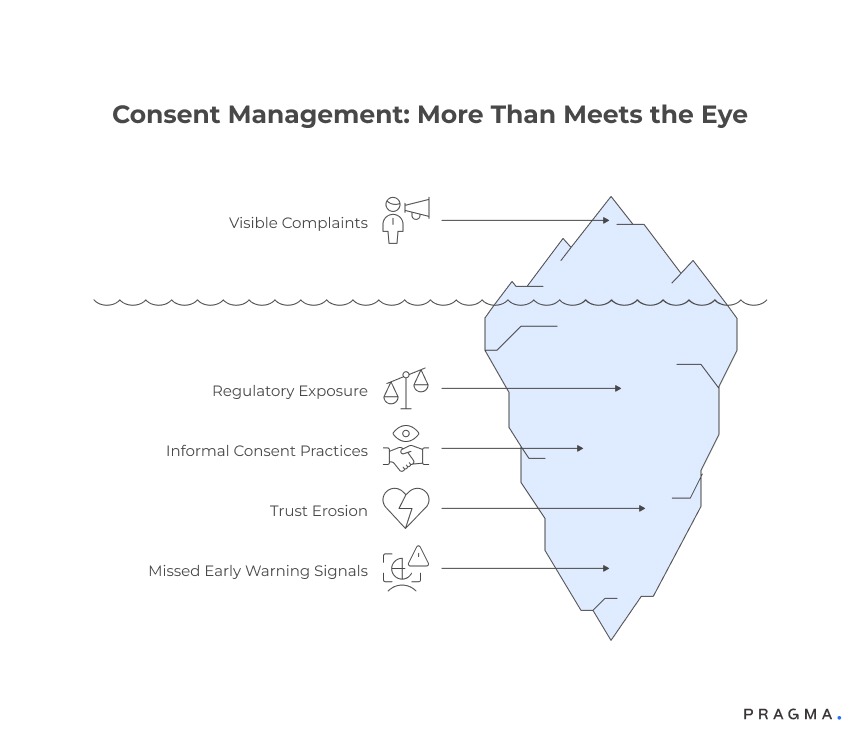
Regulatory exposure increases non-linearly with message volume
As brands expand India-wide communication, even small consent gaps can affect thousands of customers in a short span. Regulations, platform policies, and telecom enforcement are increasingly intolerant of “grey-area” consent, especially when complaints spike suddenly. What worked during early growth stages becomes operationally unsafe once outreach volume scales.
Why informal consent practices fail under scale
Consent captured through static checkboxes, verbal confirmation, or loosely documented flows cannot be enforced reliably across systems. When marketing, logistics, and support tools operate independently, consent rules get applied inconsistently. This makes violations accidental but still fully attributable to the brand.
Trust erosion happens before visible complaints
Customers rarely escalate immediately when messaging feels excessive or irrelevant. Instead, they disengage quietly by ignoring messages, muting channels, or mentally downgrading the brand’s credibility. By the time opt-outs or complaints surface, meaningful trust damage has already occurred.
Early warning signals teams often miss
Falling open rates, delayed responses to delivery messages, or rising “stop” keywords are often treated as campaign-level issues. In reality, they signal deeper failures in consent enforcement or frequency control that go unaddressed until deliverability itself is affected.
How consent expectations differ by message type
Transactional clarity does not equal promotional permission
Transactional messages rely on purpose-based consent
Order confirmations, delivery updates, and return notifications are generally accepted because they serve a clear operational purpose. Customers tolerate higher frequency here because the messages reduce uncertainty and support fulfilment.
Where brands misclassify messages
Problems arise when brands bundle cross-sell prompts, feedback nudges, or loyalty messaging into transactional flows. Even if the message is triggered by an order event, its intent matters. Blurring this line weakens implied consent and increases complaint risk.
Promotional messaging requires explicit and revocable consent
Unlike transactional updates, promotions compete for attention and tolerance. Customers expect full control over whether they receive them and through which channels.
Why “opt-in once” is not sufficient
Customer intent changes over time. A one-time opt-in at checkout does not justify long-term promotional outreach unless preferences are actively respected and easy to modify. Brands that ignore this see higher unsubscribe and spam rates during campaigns.
Why channel-level consent tracking is essential in India
Each channel carries different expectations and enforcement norms
Customer tolerance varies sharply by channel
SMS is often accepted for critical updates, while WhatsApp carries a more personal expectation. Email allows more volume but is easier to ignore. Treating all channels as interchangeable leads to poor engagement and higher opt-out rates.
Real-world consent mismatch scenario
A customer may approve SMS delivery updates but reject WhatsApp messages after receiving repeated promotional nudges. Without channel-level consent enforcement, brands continue messaging and trigger complaints despite having “global” consent on record.
Platform enforcement is uneven but unforgiving
WhatsApp, telecom operators, and email providers apply different thresholds for blocking or penalising senders. Violations in one channel can affect overall sender reputation.
Operational implication for ops and CRM teams
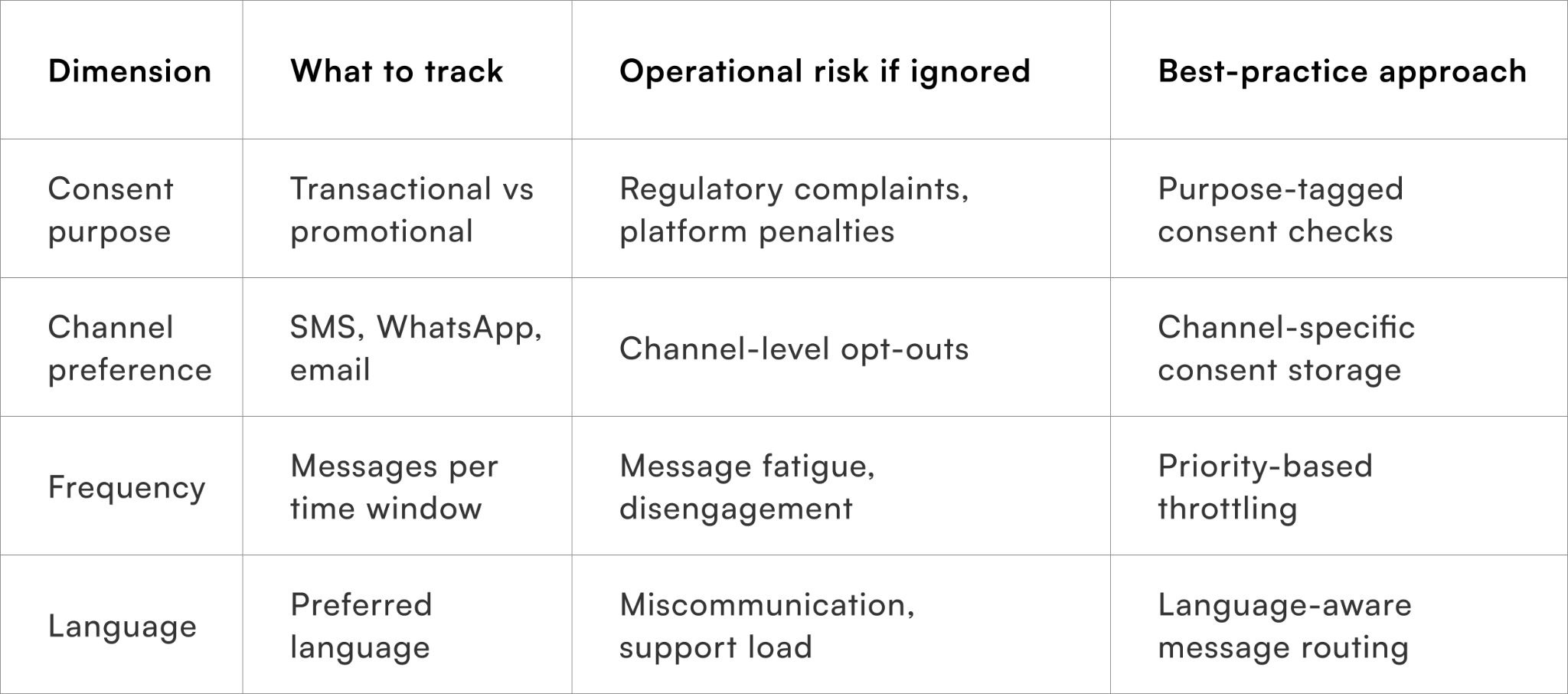
Consent must be stored and evaluated at the channel + purpose level, not as a single boolean flag. Messaging systems should check both before every send, not after complaints arise.
Why preference management goes beyond compliance
Relevance determines whether consent remains meaningful
Content preferences shape perceived message value
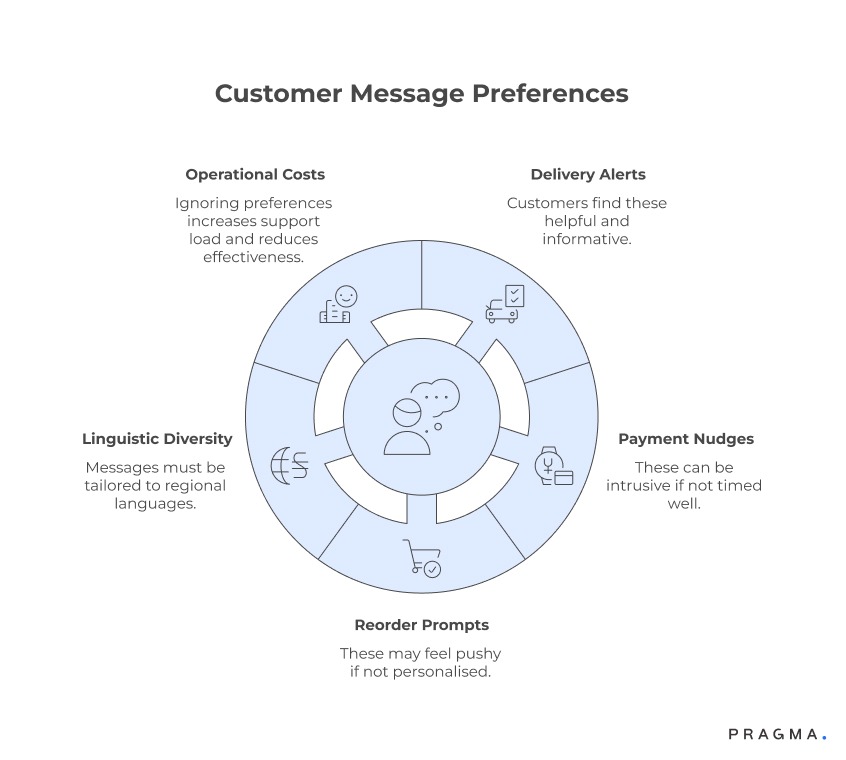
Even when consent exists, customers respond differently to various message categories. Delivery alerts feel helpful, while payment nudges or reorder prompts may feel intrusive if poorly timed.
Operational cost of ignoring preferences
When customers receive messages they did not expect, they contact support, escalate complaints, or disengage entirely. This increases support load and reduces the effectiveness of even critical messages.
Language and regional preferences affect comprehension
India’s linguistic diversity means a “consented” message can still fail if delivered in the wrong language. Poor comprehension leads to missed actions and avoidable support queries.
Why default-language assumptions break at scale
Using a single language for all communication may work initially but fails as brands expand into Tier 2 and Tier 3 regions. Preference-aware language selection improves clarity and reduces operational friction.
The hidden operational cost of poor frequency control
Over-messaging creates noise, not clarity
Frequency spikes during operational exceptions
Delays, failed deliveries, or return events often trigger multiple automated messages within short windows. Each system sends “useful” updates, but the combined effect overwhelms the customer.
How this impacts delivery and support outcomes
Customers stop reading messages altogether, missing critical updates. Support teams then handle avoidable “Where is my order?” queries despite messages being technically sent.
System-level misalignment causes message floods
CRM, logistics, payments, and marketing tools often operate without shared frequency rules. Each system optimises for its own success metric, not the customer’s experience.
Why frequency control must sit centrally
Without a shared throttle or prioritisation layer, brands cannot prevent message collisions. Central frequency management ensures important updates cut through while non-critical messages are deferred or suppressed.
Designing a single source of truth for consent and preferences
Fragmented data makes enforcement unreliable at scale
Why decentralised consent data breaks enforcement
When consent and preferences are stored separately across marketing tools, CRMs, and support systems, enforcement becomes inconsistent. One system may respect opt-outs while another continues sending messages, creating confusion and customer frustration.
Operational fallout of fragmented consent
Support teams face escalations they cannot resolve easily because no single system reflects the customer’s true state. Ops and compliance teams struggle to audit or prove adherence, increasing regulatory and platform risk during disputes.
Central consent layers as operational infrastructure
A central consent and preference service ensures every outbound message checks the same rules before being sent. This turns consent from a policy document into an enforceable operational control.
What a functional consent layer must support
It should store consent by purpose, channel, language, and timestamp, and expose real-time APIs to all messaging systems. Without real-time checks, enforcement degrades into periodic cleanups, which is too late at scale.
Implementing frequency guardrails without killing urgency
Not all messages deserve equal priority
Understanding message criticality
Delivery failures, payment issues, and return pickups carry higher urgency than promotions or feedback nudges. Treating all messages equally creates noise and reduces the effectiveness of genuinely important updates.
Why customers mentally prioritise messages
Customers subconsciously filter messages based on perceived value. If non-critical messages arrive too often, critical ones lose attention, even if they are operationally important.
Building prioritisation into frequency logic
Effective frequency management does not mean fewer messages overall, but smarter sequencing. High-priority operational messages should bypass caps, while low-priority messages are deferred or dropped during active order windows.
Operational example during peak seasons
During sale periods, brands often trigger multiple promotional and order-related messages simultaneously. A priority-based throttle ensures delivery updates are always sent, while marketing messages are suppressed until fulfilment stabilises.
Operationalising consent and frequency across teams
Governance matters as much as tooling
Why ownership ambiguity causes breakdowns
When consent violations occur, teams often blame tools rather than process gaps. Marketing optimises for reach, ops for updates, and support for resolution, with no shared accountability for message experience.
The cost of unclear ownership
Without defined ownership, frequency creep happens slowly and invisibly. Each team adds “just one more message” until customers feel overwhelmed and opt out entirely.
Establishing cross-functional guardrails
Successful brands define consent and frequency rules jointly across marketing, ops, legal, and support. These rules are documented, enforced in systems, and reviewed regularly.
What governance looks like in practice
Changes to message types or triggers require approval against consent impact. Dashboards track opt-outs, complaints, and message volumes by category, not just by campaign.
Measuring whether consent-led communication is actually working
Compliance alone is not success
Moving beyond opt-in counts
High opt-in numbers mean little if engagement is falling or complaints are rising. Teams must track how consent translates into meaningful interactions.
Signals that indicate healthy communication
Stable opt-in rates, consistent engagement with transactional messages, and low complaint ratios suggest that frequency and relevance are aligned with customer expectations.
Using metrics to refine rules continuously
Consent and frequency rules should evolve based on data, not assumptions. Regional behaviour, channel tolerance, and lifecycle stages all influence optimal messaging.
Operational feedback loops
Insights from delivery delays, support tickets, and unsubscribe reasons should feed back into consent logic. This prevents static rules from becoming outdated as scale and behaviour change.
Consent, preference, and frequency control by dimension
Quick wins for implementing consent-led, frequency-aware outreach
Practical steps to regain control without disrupting active communication
Week 1 – Map every message and its trigger
Start by cataloguing all outbound messages across SMS, WhatsApp, email, and IVR. Document what triggers each message, which system sends it, and whether it is transactional or promotional. This exercise usually reveals duplicate messages and unclear ownership immediately.
Why this step unlocks clarity
Most frequency issues come from teams not realising how many messages a customer receives during a single order lifecycle. Visibility creates the foundation for prioritisation and control.
Week 2 – Define consent and priority rules
Explicitly classify messages by purpose and urgency. Decide which messages must always be sent, which can be deferred, and which require explicit opt-in. Align these rules across marketing, ops, and support.
Expected operational outcome
Teams stop debating message-by-message decisions and instead rely on shared rules, reducing accidental violations and internal friction.
Week 3 – Centralise enforcement, not just storage
Implement a single consent and frequency check that every outbound message must pass through. Ensure it evaluates purpose, channel, language, and recent message history before allowing a send.
Why enforcement matters more than dashboards
Dashboards show problems after they occur. Real-time enforcement prevents violations before customers experience them.
Week 4 – Train teams and set review cadence
Train all teams on how consent and frequency rules work and why they exist. Establish a monthly review to assess opt-outs, complaints, and engagement shifts.
Long-term benefit
Consent management evolves with customer behaviour instead of becoming a static compliance exercise.
Metrics that indicate healthy, consent-led communication
Measure trust and relevance, not just reach
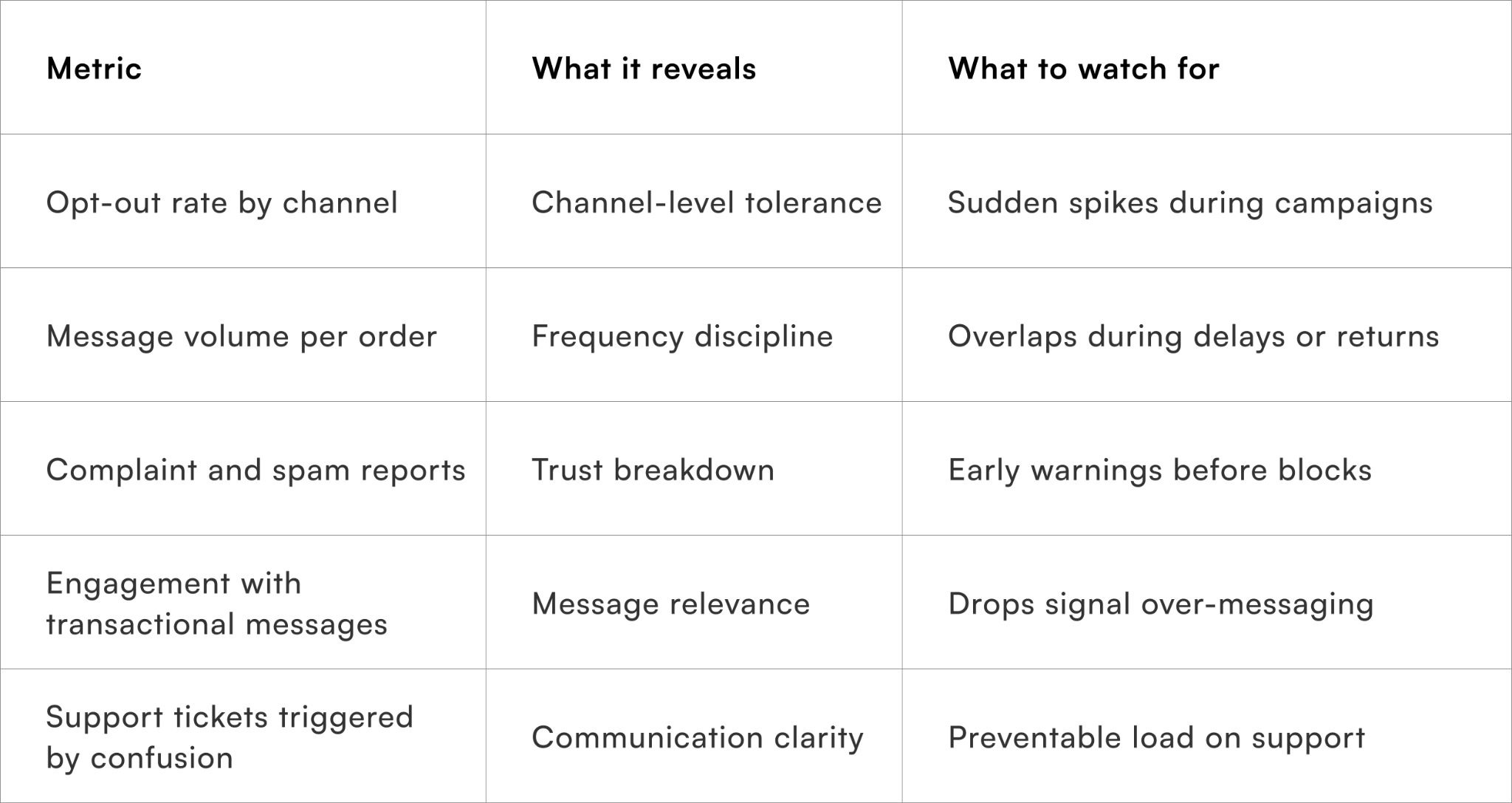
Tracking these metrics together helps teams understand whether communication is helpful or harmful, even when technically compliant.
To Wrap It Up
India-wide outreach only scales sustainably when consent, preferences, and frequency are treated as operational systems, not campaign settings. Brands that centralise enforcement and prioritise message relevance protect both deliverability and customer trust.
This week, map every outbound message and define which ones truly deserve to reach the customer.
Over the long term, continuously refine consent rules using engagement, complaints, and support signals to stay aligned with evolving customer expectations.
For D2C brands seeking structured, consent-led communication at scale, Pragma’s communication governance platform helps unify consent, preferences, and frequency controls so critical messages land while unnecessary noise is eliminated.

FAQs (Frequently Asked Questions On Consent, preference and message frequency management for India-wide outreach)
1. Is implied consent enough for transactional messaging in India?
Implied consent is generally acceptable for essential operational updates, but it must be tightly scoped to purpose and not abused for promotional content.
2. Do customers really care about message frequency?
Yes. Customers may not complain immediately, but excessive messaging leads to disengagement, muted channels, and eventual opt-outs.
3. Should consent be managed separately for each channel?
Absolutely. Channel-level consent reflects real customer expectations and platform enforcement differences.
4. How often should consent and frequency rules be reviewed?
At least quarterly, and immediately after major sales events, product launches, or channel expansions.
5. Can frequency control hurt conversion?
Short term, possibly. Long term, it improves trust, engagement, and deliverability, which outweighs marginal campaign gains.
Talk to our experts for a customised solution that can maximise your sales funnel
Book a demo

.png)
.png)