Why does customer trust weaken despite good products?
A young D2C skincare brand based in Mumbai notices something odd. Repeat customers browse frequently, add items worth ₹1,200—₹1,800, even revisit the PDP three or four times—yet nearly 42% of these warm shoppers abandon the purchase at the very last moment. Meanwhile, a fashion label in Jaipur sees a similar pattern: customers love the designs, keep the items in cart for days, but don't convert until a heavy discount appears. And when the discount doesn't appear, neither does the order.
Across Indian D2C categories, this friction is becoming familiar. A 2024 Cachefree report showed that 62% of shoppers drop off not due to price, but due to trust gaps—ranging from order quality doubts to unclear delivery expectations. Another study by LocalCircles found that 48% of online shoppers hesitate with new or niche D2C brands due to uncertainty around returns, authenticity, and issue resolution. Discounts and speed help, but they no longer anchor confidence the way they once did.
The micro-breakpoints where trust collapses
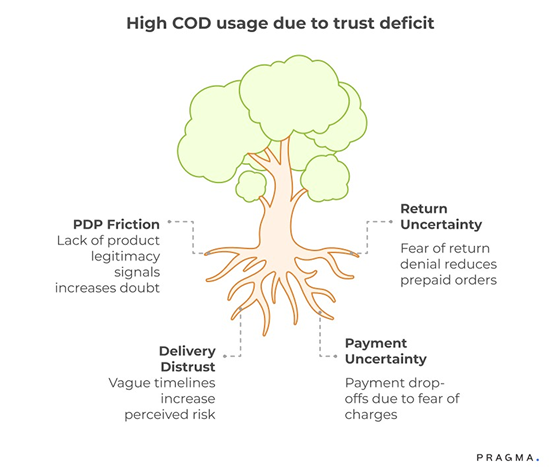
Breakpoint 1: A young D2C skincare brand based in Mumbai notices something odd. Repeat customers browse frequently, add items worth ₹1,200—₹1,800, even revisit the PDP three or four times—yet nearly 42% of these warm shoppers abandon the purchase at the very last moment. Meanwhile, a fashion label in Jaipur sees a similar pattern: customers love the designs, keep the items in cart for days, but don't convert until a heavy discount appears. And when the discount doesn't appear, neither does the order.
Breakpoint 2: Across Indian D2C categories, this friction is becoming familiar. A 2024 Cachefree report showed that 62% of shoppers drop off not due to price, but due to trust gaps—ranging from order quality doubts to unclear delivery expectations. Another study by LocalCircles found that 48% of online shoppers hesitate with new or niche D2C brands due to uncertainty around returns, authenticity, and issue resolution. Discounts and speed help, but they no longer anchor confidence the way they once did.
Breakpoint 3: Delivery timeline distrust
Another study by LocalCircles found that 48% of online shoppers hesitate with new or niche D2C brands due to uncertainty around returns, authenticity, and issue resolution. Discounts and speed help, but they no longer anchor confidence the way they once did. Another study by LocalCircles found that 48% of online shoppers hesitate with new or niche D2C brands due to uncertainty around returns, authenticity, and issue resolution. Discounts and speed help, but they no longer anchor confidence the way they once did. Another study by LocalCircles found that 48% of online shoppers hesitate with new or niche D2C brands due to uncertainty around returns, authenticity, and issue resolution. Discounts and speed help, but they no longer anchor confidence the way they once did.
Behaviour from Pragma
A young D2C skincare brand based in Mumbai notices something odd. Repeat customers browse frequently, add items worth ₹1,200—₹1,800, even revisit the PDP three or four times—yet nearly 42% of these warm shoppers abandon the purchase at the very last moment. Meanwhile, a fashion label in Jaipur sees a similar pattern: customers love the designs, keep the items in cart for days, but don't convert until a heavy discount appears. And when the discount doesn't appear, neither does the order.
Strategic Implementation
Implementing a trust-first strategy requires coordination across marketing, operations, and customer support.
Post-Purchase Optimisation
The journey doesn't end at checkout. Optimising the post-purchase experience is crucial for long-term loyalty.
Customer Retention Metrics
Track Repeat Purchase Rate (RPR) and Customer Lifetime Value (CLV) to measure the success of your trust initiatives.
Scaling Your D2C Brand
As you scale, maintaining the same level of trust becomes a logistical challenge that requires automation.
Future of Indian E-commerce
The next wave of e-commerce growth in India will be driven by trust and community-led brands.
Final Thoughts & Conclusion
In conclusion, trust is not a one-time setup but a continuous effort to provide value and transparency to your customers.